LEED vs BREEAM: Which Certification Fits Your Hospitality Project

LEED and BREEAM both certify that a building performs better environmentally, but they get there differently. LEED is a point-based checklist run by the U.S. Green Building Council, and it is the natural default for projects in the United States. BREEAM is a weighted assessment from the UK's BRE Group, and it is strongest where it is already the market language, mainly the UK and Europe. For a hotel or restaurant, the right choice usually comes down to where the asset sits, who will read the plaque (lenders, brand partners, guests, investors), and how early your design team builds the target into the concept.
TL;DR
- LEED scores a project on points with no category weighting. BREEAM weights its categories so that some environmental impacts count for more than others.
- LEED has four levels (Certified, Silver, Gold, Platinum). BREEAM has five (Pass, Good, Very Good, Excellent, Outstanding).
- Independent research found about 83% overlap between the two systems, so much of the design work serves either one.
- Both publish fee schedules. LEED fees depend on rating system, size and membership. BREEAM fees for USA and Canada projects are set in USD.
- Pick the system your market, brand partners and investors already recognize, then decide before concept design, not after drawings are done.
Table of Contents
- What LEED and BREEAM actually are
- How the scoring differs
- Certification levels side by side
- What each certification costs
- Which one fits a hotel or restaurant
- Where interior design earns the credits
- Process, timing and documentation
- Our perspective
- How BOOM Project supports a certification-ready design
- FAQ
- Sources
What LEED and BREEAM actually are
LEED stands for Leadership in Energy and Environmental Design. The U.S. Green Building Council describes it as [the most widely used green building rating system] in the world, and says it can be applied to virtually all building types and phases. Its newest version, LEED v5,[addresses a low-carbon future] alongside equity, health, ecosystems and resilience.
BREEAM is the older of the two in terms of origin. BRE describes it as [the world-leading sustainability assessment method] for the built environment and infrastructure, with third-party certified standards in use since 1990. It looks at whole-life performance,from design and construction through use and refurbishment. A professional comparison of rating systems also notes that BREEAM is [globally applicable], with locally adapted versions of some standards in countries such as the Netherlands and Spain.
For a hospitality owner, the practical reading is simple. Both are third-party verified. Both can cover new builds, fit-outs and operating buildings. Neither is a design style: a LEED Gold hotel can look like anything, which is exactly why the interior design brief matters.
How the scoring differs
The core difference sits in how each system turns performance into a result. A comparison document published by BRE explains that LEED uses a point-based checklist without category weighting,[while BREEAM uses a weighted system] that prioritizes environmental impact categories. That document dates from 2008, so treat it as a description of the logic rather than of today's credit lists.
What this means in practice:
- In LEED, you earn points across credits, and every point counts the same toward your level. Teams often choose the credits that are cheapest or easiest for the building,as long as all prerequisites are complete. LEED certification [requires completion of all prerequisites].
- In BREEAM, a credit in a heavily weighted category moves your score more than a credit in a lightly weighted one. Your result is built from category percentages, so the weighting shapes your strategy.
An academic criteria-based comparison from 2018 found [an 83% overlap between LEED and BREEAM], with BREEAM generally having a higher number of specific issues to fulfill. For an owner, that overlap is good news: energy performance, water, materials, indoor environmental quality and site decisions are addressed by both, so a well-documented design is not wasted if you switch targets early.
Certification levels side by side
Levels are how your result gets communicated to guests, tenants and investors, so it helps to know what each ladder looks like.
| Feature | LEED | BREEAM |
|---|---|---|
| Scoring approach | Points, no category weighting | Weighted categories |
| Levels | Certified, Silver, Gold, Platinum | Pass, Good, Very Good, Excellent, Outstanding |
| Number of levels | 4 | 5 |
| Run by | U.S. Green Building Council | BRE Group |
| Home market | United States | United Kingdom |
| Lifecycle focus | Design, construction, operations | Whole life, from design to refurbishment |
Sources for the table:[level names and approach],[LEED],[BREEAM].
LEED point thresholds
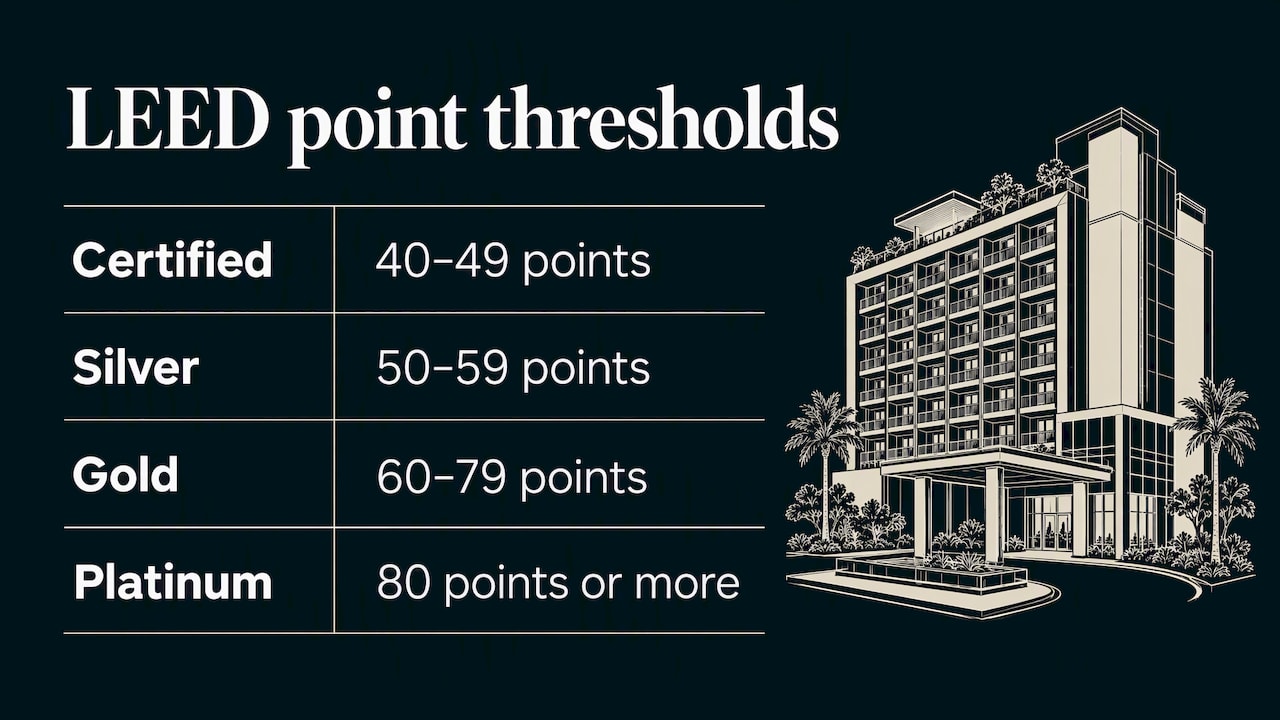
The USGBC sets these thresholds for the levels: Certified at 40 to 49 points, Silver at 50 to 59, Gold at 60 to 79,[and Platinum at 80 or more]. A restaurant fit-out with a tight budget might aim for Certified or Silver and still earn a recognized result. A flagship hotel with an ESG commitment from its investors often targets Gold.
BREEAM and operating buildings
BREEAM also offers an in-use scheme for existing assets. According to the ENERGY STAR comparison of rating systems,BREEAM In-Use [has nine weighted categories] reflecting environmental performance, occupant health and wellbeing, and protection and growth of the asset's financial value. That last point matters to operators who think of the building as an investment,and it is the same logic behind looking at a [property from the guest's perspective]: comfort, health and asset value all show up in how a stay feels and what the building is worth.
What each certification costs
Budget for two separate lines: the certification body's fees, and the design, commissioning and documentation work that earns the credits. The second is usually larger, and it is where a design studio's early involvement saves money.
LEED fees
USGBC states that LEED registration and certification fees depend on the rating system,[project size and membership status]. For LEED BD+C (Building Design and Construction), registration is $1,350 for Silver, Gold and Platinum level members and $1,700 for organizational-level members or nonmembers, with the certification review cost based on the project's gross floor area. Always check the current schedule on the USGBC page before you budget, because the fee table is updated.
BREEAM fees
BRE's fee schedule for projects in the USA and Canada is set in USD as of September 1, 2026. For New Construction (Non-residential), registration is $1,750, and total certification fees range from $4,000 for projects under 50,000 sq ft to $15,000 for those of 500,[000 sq ft and greater]. A boutique hotel or a single restaurant will sit at the lower end of that range.
Costs beyond the fees
Fees are the visible part. The larger cost is what the building needs to qualify: efficient mechanical systems, better envelope detailing, low-emitting materials, water-efficient fixtures, commissioning and documentation. These costs vary by building size, project complexity and the target level. One Portuguese source puts the extra cost of certified construction or renovation at 2% to 8% of total work value, but that is a single-country estimate from a commercial page and should not be read as a US benchmark. Build your own estimate with your design team and cost consultant.
On the other side of the ledger,certification investment can [amortize through property-value gains], though how much depends on your market and asset.
Which one fits a hotel or restaurant
Ask these questions in order.
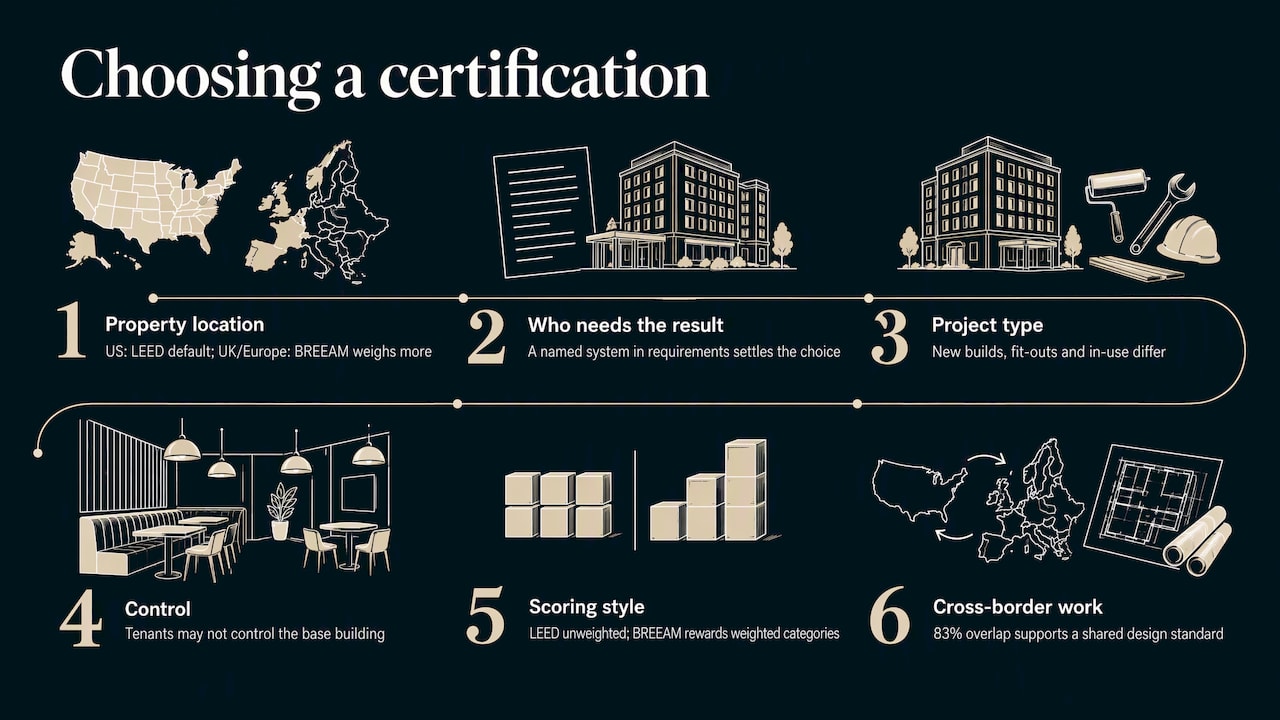
1. Where is the property? In the United States, LEED is the default language of lenders, municipalities and corporate travel buyers. Outside the US, and especially in the UK and parts of Europe, BREEAM often carries more weight. BRE describes BREEAM as a framework meant to increase asset value,[decrease costs and support ESG goals] through third-party validation, and it now publishes fees in USD for North American projects, so it is a real option on this side of the Atlantic too.
2. Who needs to see the result? If a brand partner, an investor or a lender names one system in their requirements, that settles it. Ask before you design, not after.
3. New build, fit-out or operating asset? A hotel renovation, a restaurant fit-out in a leased space and a ground-up resort do not face the same credit paths. In-use schemes suit owners who want to improve a building they already operate.
4. How much control do you have? A tenant restaurant often controls interiors, furniture, finishes, lighting and fixtures, but not the base building. That narrows the realistic credits, and it is worth mapping before you register.
5. Do you prefer flexibility or structure? LEED's unweighted points let a team pick credits that suit the site. BREEAM's weighted structure rewards teams that focus on the heavier categories.
If you operate in several countries, the 83% overlap makes a shared design standard feasible: design once to a high environmental baseline, then document for the system each market requires.
Where interior design earns the credits
Owners often assume certification is an engineering exercise. In hospitality, a large share of what guests touch and what operators maintain comes from the interior scope, and it is where early decisions pay off.
- Lighting. Efficient fixtures,controls and layered schemes cut energy use without making a lobby feel clinical. See our guide to [hotel lighting design] for how layers and specs work together.
- Materials and finishes. Low-emitting paints, adhesives and flooring, and responsibly sourced products,support indoor environmental quality. Our notes on [restaurant flooring options]and [commercial upholstery fabrics] show how durability and cleanability fit into material choices.
- FF&E. Furniture selection affects materials credits,and the cost gap between purchase price and installed cost is easy to underestimate. Our article on [FF&E for hotel owners] explains how to budget for it.
- Ventilation and air quality. Kitchens and dining rooms share air. [Restaurant ventilation design] decisions made early affect both comfort and any indoor air quality credits you pursue. - Brand standards. Many hotel brands already specify sustainability measures,so read [how brand standards work] before you set a certification target.
Food service is another area where certification goals meet daily operations. If your hotel or restaurant has a kitchen,this overview of [sustainability in food services] is a practical companion to the building-side credits you pursue under LEED v5.
Process, timing and documentation
Both systems follow the same broad arc: choose the scheme and level, register the project, design and build with the credit requirements in mind, collect documentation, and submit for third-party review. LEED requires all prerequisites to be complete before any points count toward a level.
How long this takes depends on the project's size, how early the target was set, and how quickly the team assembles evidence. We do not quote a standard timeline because it varies widely, and the certification bodies' own pages are the place to confirm review stages and current requirements. What we can say from experience with design projects is that documentation is far easier when product data, drawings and supplier records are organized as the work happens rather than reconstructed at the end.
Our perspective
We design hospitality interiors, so we see certification from the point where decisions become physical: a finish schedule, a lighting plan, a furniture list. Our view is that the choice between LEED and BREEAM matters less than the moment you choose.
A target set during preliminary design shapes the concept, the material palette and the budget. A target set after execution drawings are issued means revisions, resubmissions and supplier changes. That is why our process runs from concept through visualization, execution drawings, furniture and materials selection, and site and supplier follow-up under one team. Credits depend on what is specified and what is actually installed, and an end-to-end process keeps those two the same.
We also believe a certified building should not feel like a compliance exercise. Guests do not read credit lists. They notice light, acoustics, air, touch and atmosphere. Our work aims to make the brand identity and the guest experience carry the project, with the sustainability target built into the same decisions rather than layered over them. For owners working across borders, a bespoke, context-specific approach also lets us adapt to whichever system the market recognizes.
— slava
How BOOM Project supports a certification-ready design
If you are planning a hotel, restaurant or large commercial space and want your design documents ready for LEED or BREEAM,we can build the target into the design from the first concept. We cover [preliminary design],[3D visualization],[execution drawings], furniture,[materials and accessories],and [site and supplier follow-up]. Our certification advice is limited to the design side; fees, formal assessment and registration stay with your certification consultant and the rating body.
To discuss your project,start from our [services page]or reach us through [BOOM Project].
FAQ
Is LEED or BREEAM better?
Neither is better in general. LEED is the stronger fit where US lenders, cities and partners expect it, while BREEAM is often preferred in the UK and Europe. Choose the one your market and stakeholders already recognize, and confirm any contractual requirement before you register.
What are the LEED levels?
LEED has four levels, awarded on points earned. Certified is 40 to 49 points, Silver 50 to 59,[Gold 60 to 79 and Platinum 80 or more]. All prerequisites must be completed first.
What are the BREEAM levels?
BREEAM has five: Pass, Good, Very Good, Excellent and Outstanding. Your level comes from a weighted score, so a credit in a heavily weighted category contributes more than one in a lightly weighted category.
Can a project hold both certifications?
It is possible, and the roughly 83% overlap found in academic research means much of the evidence carries across. Each system still has its own registration, fees and documentation, so do this only if a market or partner requires both.
How much does it cost to certify a restaurant or hotel?
Fees depend on the system and the size. LEED BD+C registration is $1,350 or $1,700 depending on membership, plus a review fee based on floor area. BREEAM USA new construction totals run from $4,000 under 50,000 sq ft up to $15,000 at 500,000 sq ft and above. Design and construction costs come on top.
Sources
- LEED rating system,[U.S. Green Building Council]
- LEED certification fees,[U.S. Green Building Council]
- Certification for Sustainable Buildings,[BREEAM]
- [BREEAM fees for USA and Canada projects] - BREEAM Platform,[BRE Group]
- Comparison of international environmental assessment methods,[BRE]
- ENERGY STAR and Green Building Rating Systems,[May 2024]
- Sustainability rating and certification systems comparison,[2025]
- Analyzing the compliance and correlation of LEED and BREEAM,[ScienceDirect]
- [Certificação LEED e BREEAM em Portugal]