Hotel Design Trends 2026: What Owners Should Act On
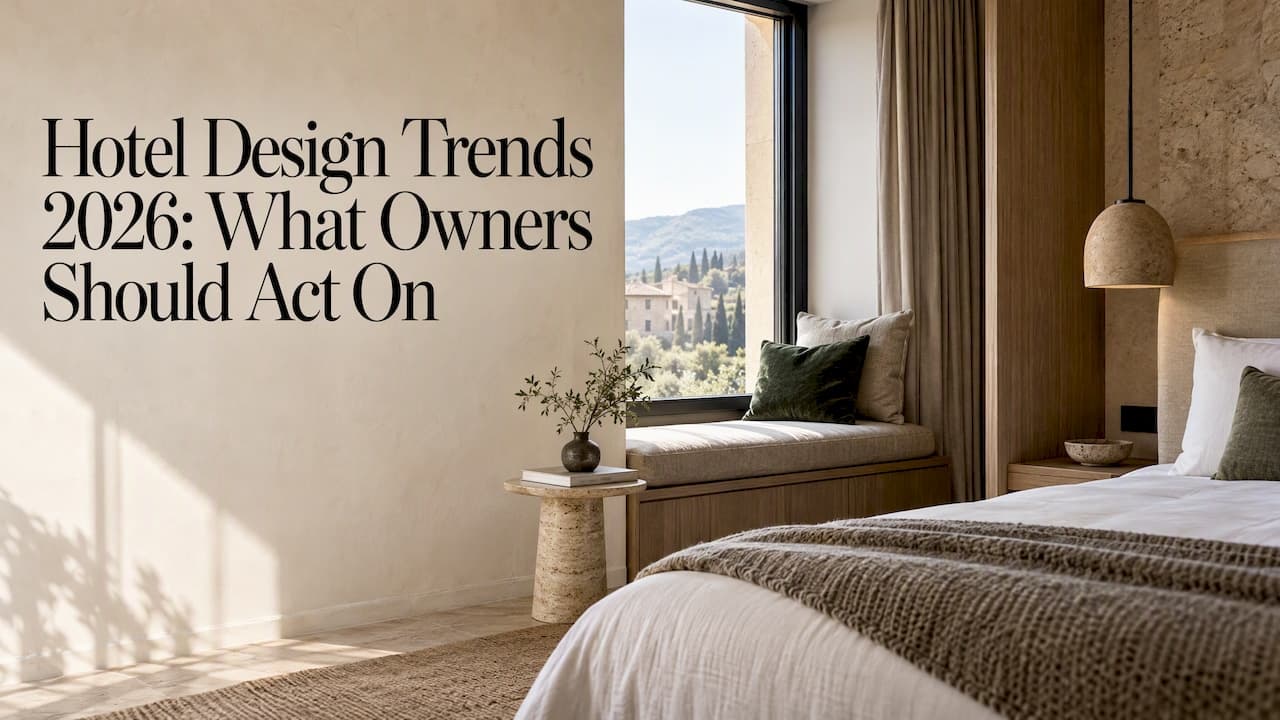
The hotel design trends that matter in 2026 share one idea: spaces should feel considered, not decorated. Owners are moving away from formal opulence and toward comfort, local character, wellness built into the room itself, and technology that stays in the background. The same logic carries into restaurants and the wider hospitality sector, so most of what follows applies to a lobby restaurant as much as to a guest room.
This guide separates what is worth budgeting for from what is only photogenic, and it says where the numbers come from.
TL;DR
- Luxury now reads as [intentionality and comfort], not formality. Guests want to feel looked after.
- Wellness is moving into the architecture: lighting, acoustics and air quality, not a separate spa menu.
- Local character beats generic luxury. Bespoke millwork, regional art and neighborhood stories are the differentiators.
- Sustainable materials cost more up front, so budget them as a lifecycle decision and keep a contingency.
- Pick two or three trends that fit your brand and guest, and design them as one system.
Table of Contents
- Comfort and intention replace formal luxury
- Wellness moves from the spa into the room
- Muted technology and frictionless stays
- Local character over generic luxury
- Flexible, multi-use social spaces
- Sustainability, with the cost stated plainly
- Trends worth ignoring, or at least delaying
- Budget like a project, not a per-room average
- Our perspective
- From trend to a buildable design
- FAQ
- Sources
Comfort and intention replace formal luxury
The clearest shift in 2026 is tonal. Industry commentary in [Hotel Business] describes the best hospitality spaces as designed to make guests feel emotionally supported, with technology that improves convenience without adding digital distraction. Hotel design, in that framing, is about orchestration: emotion, technology, sustainability and storytelling working together.
What this means in practice:
- Warm, layered rooms. Texture and lighting do more work than a statement wall. One of the pages ranking for this topic puts it bluntly: stay with warm neutrals in guest rooms and invest in texture and lighting, because nobody books for an accent wall.
- Fewer, better pieces. A smaller number of well-made items reads as calm and holds up better under wear.
- Color returns, but in controlled doses. After years of tonal restraint, richer hues and pattern are coming back, usually in lobbies, bars and corridors rather than across every guest room.
If you are deciding where color goes,start with spaces guests pass through rather than sleep in. Our note on [hotel corridor design] covers four choices that serve both guests and owners, including how a corridor can carry personality without raising maintenance.
Wellness moves from the spa into the room
The old model put wellness in a spa and charged for it. The 2026 model embeds it. According to a [Dataintelo market report], 71% of international travelers now prioritize health-oriented room features such as circadian lighting, acoustic optimization and air quality systems, and these are increasingly treated as standard rather than luxury add-ons. Treat that as a market-research estimate, not a guarantee for your property, but the direction matches what designers are saying.
Shaw Contract's [2026 hospitality design outlook] calls the goal "invisible wellness": circulation, lighting and acoustics arranged so the environment supports the guest without asking them to operate anything. For an owner, that translates to a few decisions made early:
- Lighting layers. Warm, dimmable, low-glare light at night, brighter and cooler options for morning. Plan circuits and fixtures at concept stage, not during procurement.
- Acoustics. Wall build-ups, door seals, soft finishes and corridor layout decide whether a room feels restful. They are very hard to fix after opening.
- Air and materials. Ventilation strategy and low-emission finishes belong in the specification, not the marketing copy.
- Bathrooms that survive use. A calm bathroom is also one that does not stain,corrode or take a week to repair. We wrote up [hotel bathroom design that lasts], including durable fixtures and easier repairs.
The same report notes that technology infrastructure and smart-space solutions now account for 12 to 18% of total interior design budgets in premium hotel segments. If you are in that tier, expect lighting control and room systems to compete with furniture for budget.
Muted technology and frictionless stays
Technology is not disappearing, it is going quiet. The pattern is controls that are intuitive, one-touch scenes instead of five remotes, and fewer screens demanding attention. The design brief becomes: what can the room do automatically, and what should it never ask of the guest?
Two practical tests help:
- The tired-guest test. Can someone arriving at midnight find the light switch, the charger and the curtain control without reading instructions?
- The failure test. If the system goes offline, does the room still work with ordinary switches?
Local character over generic luxury
Generic decor is easy to spot,and guests increasingly say they dislike it. [OpenTable's research] found that local character ranks as the most appealing interior style for diners in 2026, and the same material points to nearly half of consumers favoring spaces that reflect the history and culture of their neighborhood. Restaurant operators will recognize this, but hotels with lobby bars and restaurants face the same pressure.
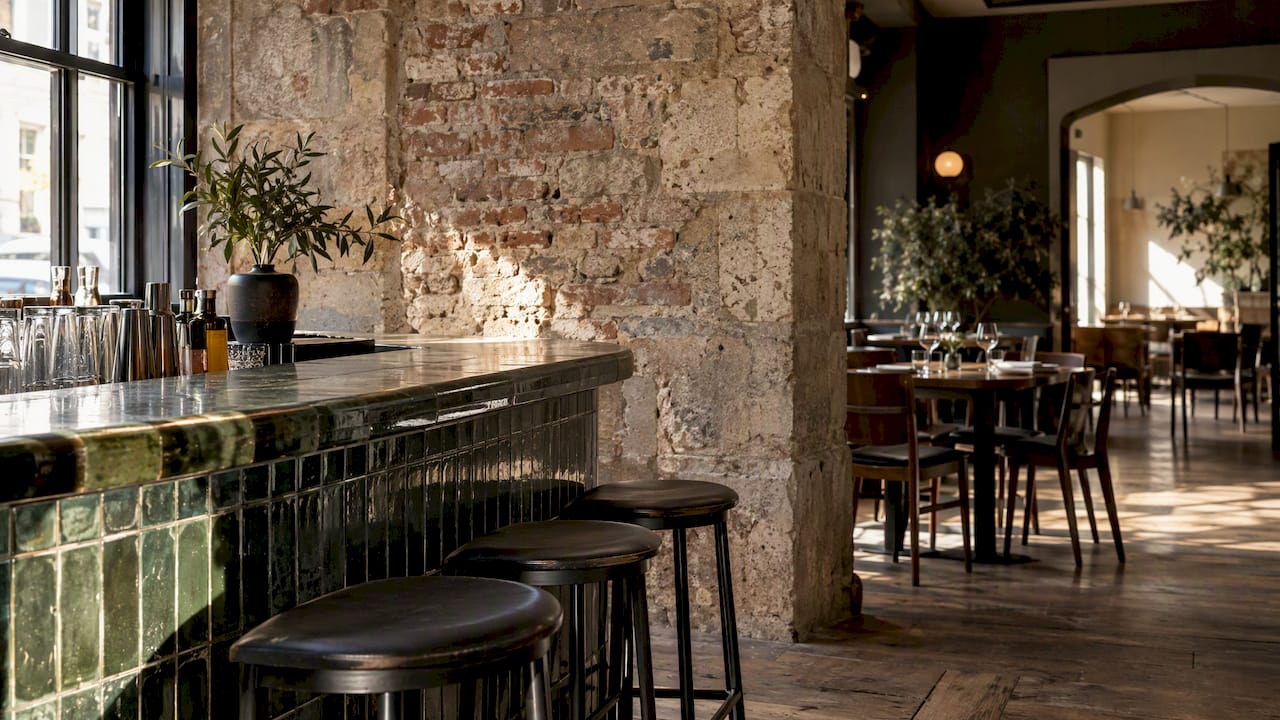
Nostalgia is part of the story. A December 2025 survey of readers of a trade magazine named [nostalgia the top design driver for 2026], at 36%, with maximalism and layered interiors next at 27%. It is a trade-reader survey, not a consumer poll, so read it as a signal of what designers expect to build rather than what every guest wants.
How to do local without costume:
- Commission bespoke millwork and local craftspeople rather than buying a catalog "heritage" look.
- Use regional art and materials with a real connection to the place.
- Tell one story well instead of five loosely. A building's former use, a street, a trade.
- Let the menu, uniforms and signage follow the same story, so the interior does not stand alone.
Our portfolio shows how this plays out across markets,from [EG LACAL-A in Vienna]to the [Queen restaurant complex in Almaty], where each interior responds to its own city and clientele rather than a template.
Flexible, multi-use social spaces
Hotel public areas are being asked to earn money all day. Reporting from Hospitality Design on [2026 development] notes that hotel spaces are increasingly offering flexible, revenue-generating social hubs, and that conversions of existing buildings are a notable part of the U.S. pipeline.
In design terms:
- A lobby that works as coworking in the morning and a bar at night needs zoned lighting and movable furniture, not just a nice sofa.
- Meeting rooms need adaptable layouts and controlled acoustics. We explain the thinking, including a reverberation target of 0.4 seconds,in [hotel meeting room design].
- Fitness and spa areas are best designed as part of the guest journey. See how that looks in our [Synergy Fitness & Spa project].
Conversions add another wrinkle: old structures bring irregular grids, low ceilings and services that were never meant for hospitality. Early site surveys and honest drawings save more money than any finish choice.
Sustainability, with the cost stated plainly
Sustainability has become a booking factor. A [2026 hotel management market report] cites survey results where majorities of travelers say sustainability credentials affect hotel choice, with 69 to 73% globally willing to pay a premium for verified sustainable lodging. Figures vary widely by market, and some of the strongest numbers come from specific countries, so do not assume them for your own guests without checking your segment.
The cost side deserves equal honesty. According to the Dataintelo report cited above, certified sustainable materials (LEED, BREEAM) raise initial FF&E material costs by roughly 8 to 12%, against operating savings of 15 to 22% over the life of the facility. Those are market-report estimates, so treat them as a planning range and test them against supplier quotes.
Where sustainability pays off in interiors:
- Durability first. The greenest chair is the one you do not replace in three years. Our piece on [commercial upholstery fabrics] explains why a high rub-count number alone does not prove a fabric is cleanable or long-lived.
- Repairability. Fixtures, hardware and modular components that can be swapped without demolition.
- Verified claims. Ask suppliers for documentation. Guests and regulators are increasingly skeptical of vague green language.
Trends worth ignoring, or at least delaying
Not every trend belongs in your project. A short filter:
| Trend | Adopt when | Hold back when |
|---|---|---|
| Bold color and pattern | You can confine it to public areas and corridors | It would be repeated across hundreds of rooms |
| Nostalgic or heritage styling | You have a genuine local story | The story is invented to fit a mood board |
| Embedded wellness | You can plan lighting, acoustics and air early | You are only adding gadgets late |
| Smart room systems | Controls stay simple and have manual fallback | Staff cannot support them |
| Certified materials | Lifecycle cost is modeled | The premium is not tied to guest or operating benefit |
Budget like a project, not a per-room average
Trend lists rarely mention money. A renovation feasibility guide from [Mingsun Group] argues against universal per-room cost estimates and says budgets should come from project-specific quantities, local labor conditions and material specifications. It also describes cost increases of around 30% often seen in Property Improvement Plans, which is why a contingency reserve belongs in the plan from day one.
A sensible order of work:
- Define the guest and the brand position before touching a mood board.
- Pick two or three trends that support that position.
- Test them on one room or one space with a visualization before committing.
- Document everything in drawings that suppliers and contractors can price consistently.
- Hold a contingency and review it at each procurement milestone.
The fourth step is where many projects lose money. Our article on [construction drawings for hospitality interiors] explains how tighter documentation cuts rework on site.
Our perspective
We design hospitality and commercial interiors, and the pattern we see most is not a shortage of trends but a shortage of coherence. An owner collects a warm palette from one reference, a smart-room system from another and a heritage story from a third, and the result feels like three hotels sharing a floor plan.
Our view is simple. A trend is only useful if it serves the brand and the guest experience, and if it can be built, maintained and cleaned by the people who will run the property. That is why we start from the brand identity and the context of the site, then work forward through concept, visualization, technical drawings, furniture and materials, and supplier follow-up. Keeping those steps under one roof is how the idea in the first render survives to the opening day.
If we had to give one piece of advice for 2026, it would be this: spend the first money on the things guests feel every night, such as light, sound, bed, bathroom and air, and spend the second on the things they photograph. Both matter, in that order.
— slava
From trend to a buildable design
If you are planning a hotel, restaurant or large commercial interior and want these ideas tested against your own site and brand,we can help at every stage. We usually begin with [preliminary design],move to [3D interior visualization] so you can judge the space before committing,and then prepare [execution drawings]for pricing and construction. See the full list on our [services page].
FAQ
What are the main hotel design trends for 2026?
The strongest are comfort-led luxury, wellness built into lighting, acoustics and air, local and nostalgic character, flexible social spaces, quieter technology and verified sustainable materials. They overlap, which is why they work best as one system rather than a checklist.
Do restaurant design trends differ from hotel trends?
Very little. Both lean on local character, warmth, texture and storytelling. Restaurants can go bolder with color and pattern because guests stay for hours, not nights, and hotel restaurants should still match the hotel's wider story.
How much should I budget for a redesign?
There is no honest universal per-room number. Budgets should be built from your quantities, local labor and material specifications, with a contingency reserve, since renovation programs often run over. We do not publish fixed prices, so scope is quoted per project.
Are sustainable materials worth the extra cost?
Often, if you model the full lifecycle. One market report estimates an 8 to 12% higher initial material cost offset by lower operating costs over time, but your result depends on the products, usage and local conditions. Ask for supplier documentation and compare quotes.
Sources
- Designing the hotel of 2026,[Hotel Business]
- Hotel Interior Design Market report,[Dataintelo]
- Hospitality design trends 2026,[Shaw Contract]
- Restaurant design trends 2026,[OpenTable]
- Nostalgia Named Top Design Driver for 2026,[rd+d]
- Hospitality's Next Wave: What's Driving 2026 Development,[Hospitality Design]
- Hotel Management Market 2026,[PW Consulting]
- Hotel Renovation Feasibility,[Mingsun Group]