FF&E for Hotel Owners: Budget for the 25–45% Installed Cost Gap
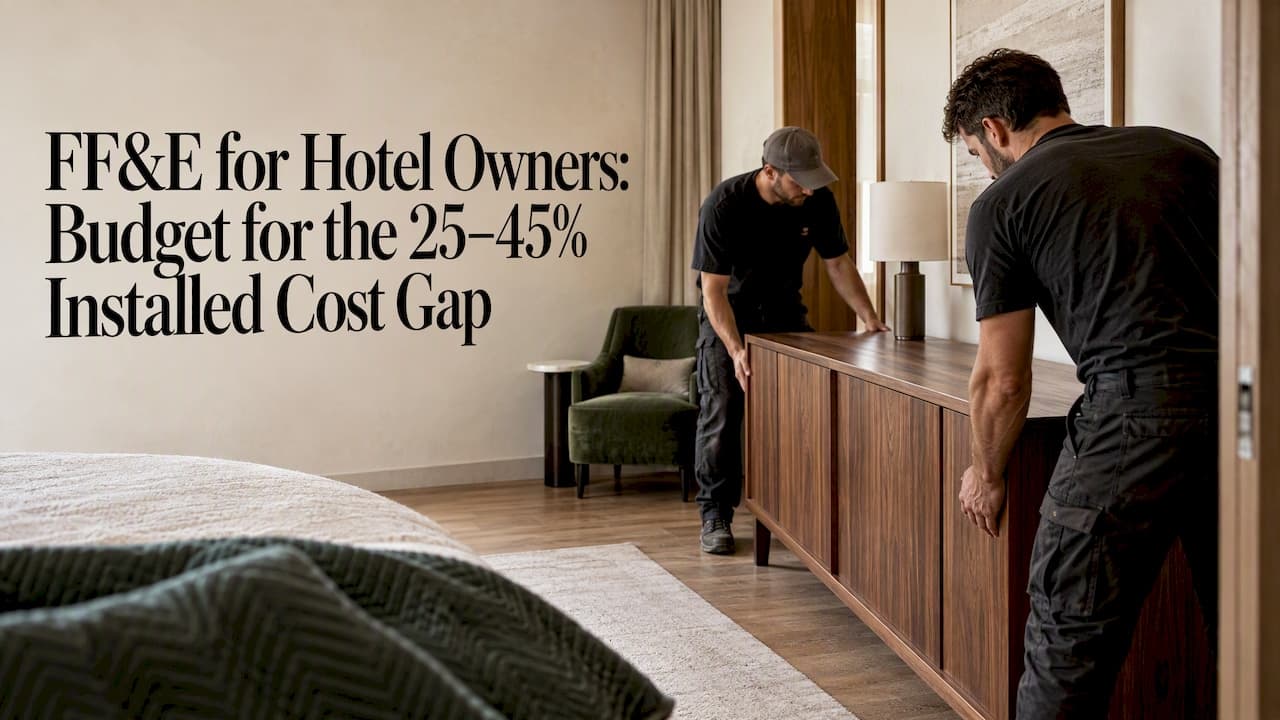
FF&E stands for furniture, fixtures and equipment, the movable items that shape how a guest experiences a room or lobby. The single rule that protects an owner's budget is simple: set per-key allowances by brand tier first, then separate the cost of goods from freight, duties and installation before any purchase order goes out. Per-key goods-only spending can range from roughly $3,000 to over $100,000 depending on property tier,according to [Global Cache].
TL;DR:
- Goods only budgets run from $3,000 to $5,000 per key for economy hotels and $30,000 to $100,000 or more for luxury properties.
- FOB quotes can understate installed costs by 25% to 45% in remote markets, so include freight, duties, warehousing, last mile delivery, and installation before approval.
- Order custom casegoods 12 to 20 weeks before installation, and wait for written mock up approval from both the owner and design team before production.
- Hold contingency by category rather than as one lump sum, and release funds only for documented quality failures, freight delays, or changes the owner approves.
- Ask material vendors for expected replacement cycles in years, then use those lifespans to set category reserves and maintenance schedules before handover.
Table of Contents
- Scope and boundaries: what belongs in FF&E vs OS&E and construction
- Typical costs and building a per-key budget
- Procurement process and timeline: from BOQ to mock-up to QA and handover
- Logistics, import costs, and installation: from FOB to installed cost
- Specifying materials and trends that affect cost, durability, and lifecycle reserves
- Common mistakes and a quick defense checklist for the FF&E budget
- BOOM Project approach: process, case examples, and what we deliver
- Maintenance planning and lifecycle management of FF&E items post-installation
- Integration of FF&E design with overall hotel brand identity and guest experience strategy
- Sustainability considerations and selecting eco-friendly FF&E materials
- Author perspective: three pragmatic priorities owners should demand
- BOOM Project services that support FF&E planning and delivery
- FAQ
- Sources
Scope and boundaries: what belongs in FF&E vs OS&E and construction
FF&E covers everything movable that furnishes a space but isn't fixed to the building envelope. Getting this boundary wrong is one of the fastest ways to blow a budget, because items get double-counted in two trades or, worse, forgotten entirely.
A typical FF&E schedule includes:
- Guestroom casegoods: beds, nightstands, desks, wardrobes
- Soft goods: drapery, upholstery, carpets, cushions
- Lighting fixtures, lamps and decorative pendants
- Bathroom accessories: mirrors, shelving, hardware
- Public-area furniture: lobby seating, restaurant tables, bar stools
- Millwork and decorative built-ins
- Food and beverage furniture and selected back-of-house equipment
Disputes usually arise around plumbing fixtures and built-in millwork, which can sit in construction scope or FF&E depending on the contract. The rule of thumb: if it's permanently fixed to a wall or floor and installed by the general contractor, it's construction; if it's selected, sourced and placed separately, it's FF&E. Clear scope language in the contract prevents procurement gaps where nobody ordered an item because each party assumed the other owned it.
Typical costs and building a per-key budget
FF&E typically represents 10 to 15% of total development cost on new builds and 25 to 40% on full renovations, according to Global Cache. Per-key goods-only benchmarks run from about $3,000 to $5,000 for economy properties up to $30,000 to $100,000 or more for luxury hotels, the same source reports.
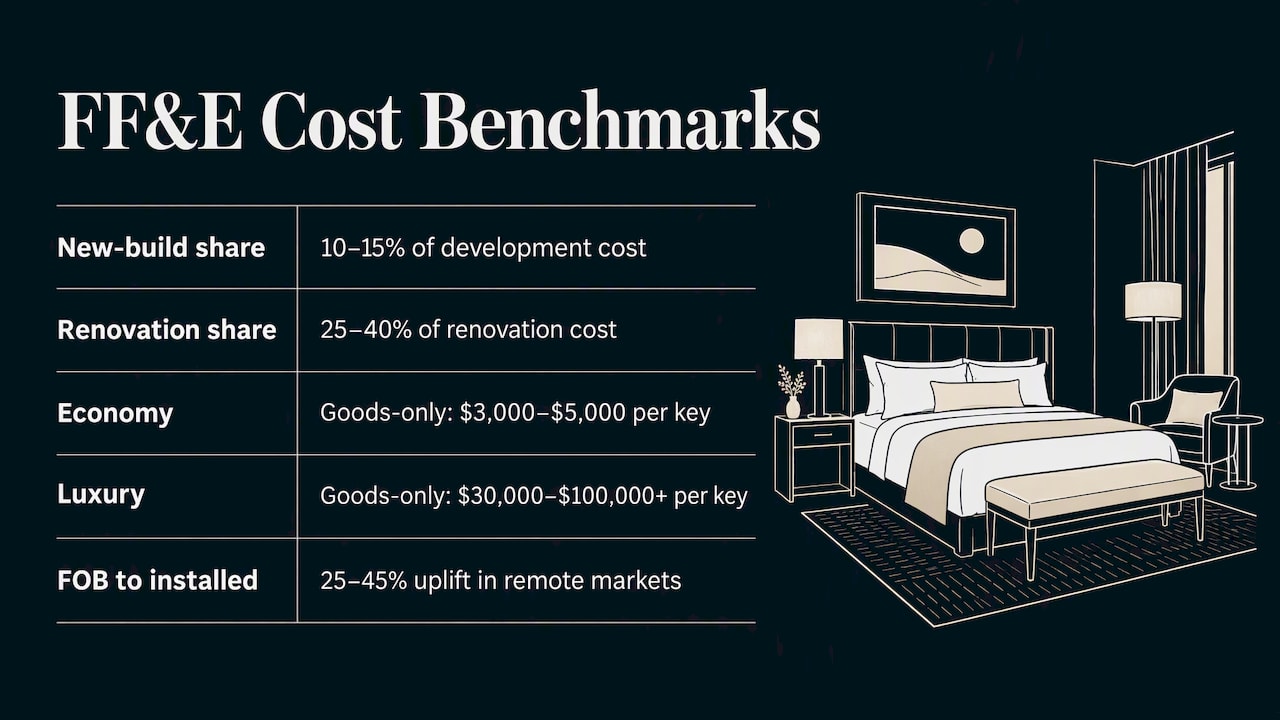
One figure owners consistently underestimate: the gap between FOB factory pricing and the actual installed cost is often 25 to 45% on projects in remote markets, driven by freight, duties, warehousing, last-mile delivery and install labor, per Global Cache. A quote that looks lean at the factory door can arrive on-site a third heavier once every add-on lands.
Industry practice calls for a contingency reserve within a moderate percentage range of the FF&E budget, held by category rather than as one lump sum. Guestroom casegoods, soft goods, lighting and public-area furniture each carry their own reserve line, and funds release only against defined triggers: a vendor failing quality control, a freight delay past an agreed threshold, or an owner-approved spec change. Lump-sum contingency tends to disappear into whichever category screams loudest; categorical contingency with trigger-based release keeps every line accountable and stops one overrun from draining the whole reserve.
Procurement process and timeline: from BOQ to mock-up to QA and handover
A disciplined procurement sequence is the difference between a predictable opening and a scramble. The steps, in order:
- Inquiry and design brief submitted to vendors or the design team
- Technical review and bill of quantities (BOQ) finalized against drawings
- Quotations gathered and commercial terms aligned with the owner
- Samples submitted and signed off by the design team and owner
- Mock-up room built and formally accepted
- Production begins once the mock-up is approved
- Packing and shipment planning, including consolidation and routing
- Delivery, installation and final handover with quality review
Long-lead items such as custom casegoods or imported stone typically need ordering windows of 12 to 20 weeks before the planned installation date, which makes early technical review a scheduling priority, not a paperwork formality. Require a signed BOQ, documented sample approvals, a written mock-up acceptance, a packing list per shipment and KPI clauses covering delivery windows and defect rates before any production run starts.
Pro Tip: Never let production begin without a written mock-up acceptance signed by both the design team and the owner's representative.
Logistics, import costs, and installation: from FOB to installed cost
Converting a factory quote into a real installed figure means stacking several cost layers on top of the goods price.
| Cost layer | Typical driver |
|---|---|
| Inland origin freight | Distance from factory to port |
| Ocean or air freight | Shipment mode and volume |
| Duties and customs | Destination country tariff schedule |
| Port handling and demurrage | Dwell time and documentation delays |
| Warehousing | Storage before site readiness |
| Last-mile delivery | Distance from port or warehouse to site |
| Install labor | Local crew availability and complexity |
Consolidating shipments into fewer, fuller containers and staging goods in a bonded warehouse close to the site reduces both demurrage exposure and last-minute install bottlenecks. Require suppliers to carry transit insurance and to commit to packing standards that match the destination's handling conditions, since a cracked headboard discovered at unboxing is a delay nobody budgeted for.
Specifying materials and trends that affect cost, durability, and lifecycle reserves
Material choices made at specification stage determine how often an owner replaces soft goods later.
- Upholstery grade and abrasion rating dictate how long seating holds up under guest turnover
- Mattress quality affects both guest reviews and replacement frequency
- Finish durability on casegoods determines whether refinishing or full replacement is needed at renovation
- Decorative lighting and personalized millwork add upfront cost but shape brand differentiation
Personalization, statement lighting and sustainable material sourcing are the three trends most likely to push a budget above benchmark, and they're worth it only when they align with the brand positioning the property is selling. A boutique property charging a premium rate justifies bespoke millwork in ways a limited-service brand does not. Specification decisions made now should feed directly into the reserve-for-replacement schedule, since a higher-grade fabric that lasts eight years instead of four changes the lifecycle math even if it costs more today.
Pro Tip: Ask every fabric and finish vendor for an expected replacement cycle in years, not just a price, and log it against your reserve plan.
Common mistakes and a quick defense checklist for the FF&E budget
The most frequent failures are predictable: benchmarking against the wrong brand tier, treating a FOB quote as the full budget, missing hidden freight and duty costs, skipping categorical contingency, and allowing approvals to slip past the point where they still protect the schedule.
Owners can demand specific mitigations from their design and procurement teams:
- Confirm every budget line is quoted as installed cost, not FOB
- Require a categorical contingency breakdown, not a single lump figure
- Insist on a mock-up acceptance before production starts on custom items
- Write delivery KPIs and defect-rate clauses into every supplier contract
- Hold attic stock for high-breakage items like mirrors and lighting
- Re-check the BOQ against drawings before any purchase order is signed
Running this checklist before issuing a single PO catches the gaps that otherwise surface during installation week, when there's no time left to fix them.
BOOM Project approach: process, case examples, and what we deliver
We map our own services directly onto these procurement checkpoints. [Preliminary Design] sets the brief before specification locks in,[3D Interior Visualization] lets owners approve direction before sampling,[Execution Drawings][reduce rework] at the supplier stage, and our furniture,[materials and accessories]service carries selection through to procurement. Our [site and supplier follow-up] work helps keep delivery on schedule by catching quality issues before they reach the guest floor.
Maintenance planning and lifecycle management of FF&E items post-installation
FF&E doesn't stop being a budget line once it's installed. Every category has a different wear curve, and a maintenance plan built at handover protects the investment made at procurement.
Soft goods like drapery and upholstery typically need cleaning schedules tied to occupancy levels, with replacement planned around visible wear rather than a fixed calendar date. Casegoods and millwork need periodic inspection for joint integrity and finish degradation, especially in high-humidity bathrooms or sun-exposed window seats. Lighting fixtures require a spare-parts inventory for bulbs, drivers and diffusers that match the original specification, since swapping in a mismatched replacement during a shortage undercuts the room's design coherence.
A practical lifecycle plan assigns each FF&E category an expected replacement window at the point of specification, not after the fact. Mattresses, for instance, commonly run shorter cycles than casegoods, and public-area seating in high-traffic lobbies wears faster than guestroom furniture that sees lighter use. Building these windows into the operating budget from day one means a renovation reserve is funded gradually instead of appearing as a shock expense five years in.
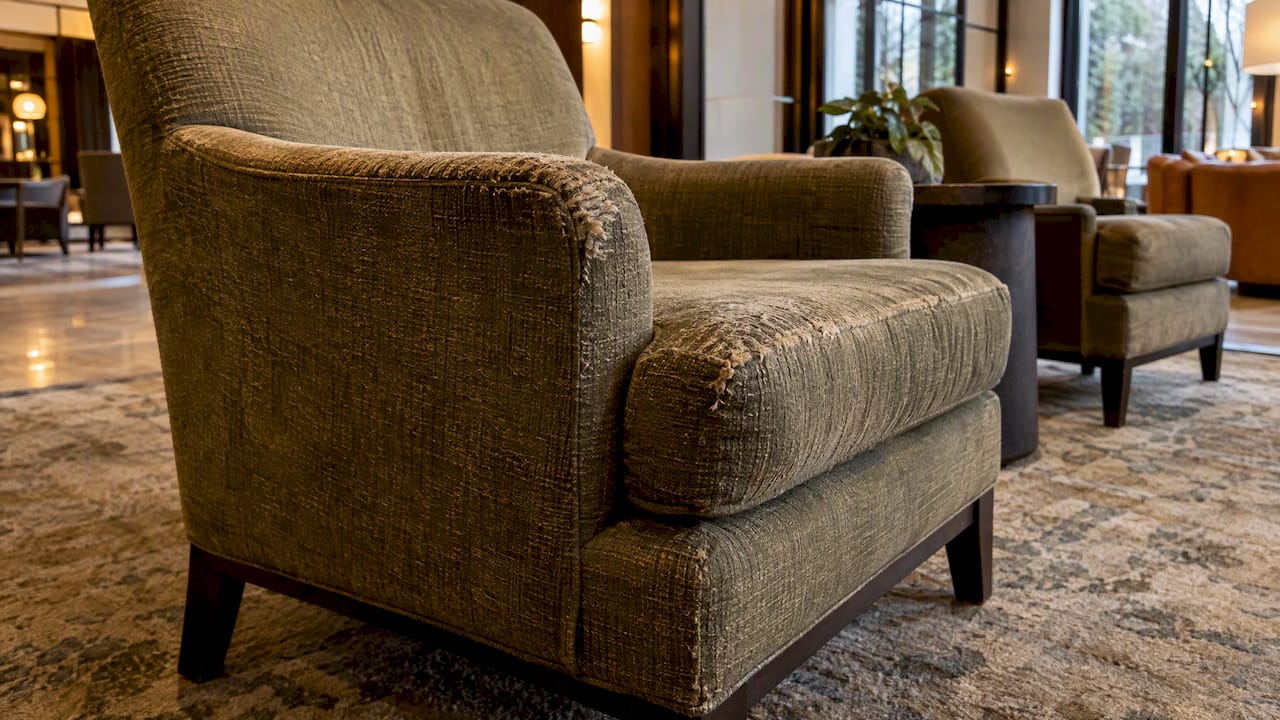
Attic stock, the practice of holding spare units of fragile or custom items, pays for itself the first time a shipment arrives damaged or a vendor discontinues a finish. Keeping even a small reserve of extra lamps, decorative hardware or fabric yardage avoids a scramble to rematch a discontinued pattern years after opening. Pairing this with a documented maintenance log, tracking what was cleaned, repaired or replaced and when, gives the next renovation team a clear starting point instead of a guessing game.
Integration of FF&E design with overall hotel brand identity and guest experience strategy
FF&E choices are one of the clearest ways a brand identity becomes something a guest can touch. The furniture, lighting and material palette in a lobby or guestroom either reinforces the story a hotel is telling or quietly contradicts it, and guests notice the mismatch even when they can't name it.
A limited-service brand built around efficiency benefits from durable, low-maintenance casegoods and simplified soft goods that support fast turnover without looking cheap. A boutique or luxury property, by contrast, often leans on bespoke millwork, layered lighting and locally sourced materials to create a sense of place that a guest can't get from a chain down the street. Neither approach is better in the abstract. The mismatch happens when a property's rate and positioning promise one experience while the FF&E delivers another.
This is also where guest experience strategy and FF&E specification have to be worked out together rather than in sequence. Lighting layers affect how a restaurant feels at dinner service. Seating depth and fabric choice affect how long a guest lingers in a lobby bar. Decisions made in isolation by a procurement team chasing a budget number, without reference to how the brand wants a space to function, tend to produce rooms that are correctly priced and wrong for the guest. Coordinating concept design, visualization and furniture selection as one continuous process, rather than three separate handoffs,is what keeps brand intent intact from sketch to installed room. Public-area choices like [corridor design] carry outsized weight here, since corridors are where guests form a first impression before they ever reach a room.
Sustainability considerations and selecting eco-friendly FF&E materials
Sustainable material sourcing has moved from a nice-to-have to a budget line item that owners need to plan for deliberately. Choosing FSC-certified wood, recycled-content textiles or low-VOC finishes often carries a premium over conventional materials, and that premium needs to be weighed against both guest expectations and the property's positioning.
The calculation differs by brand tier. A property marketing itself on environmental credentials gains real guest-facing value from visible sustainable choices, whether that's reclaimed wood casegoods or natural fiber carpets, and the added cost supports the story being told. A property without that positioning may get less return on the same spend, though durability gains from quality natural materials can still justify the choice on lifecycle grounds alone.
Sustainability decisions also intersect with the logistics side of the budget. Locally sourced materials cut freight distance and the associated duties and demurrage risk discussed earlier, which can offset part of a sustainable material's upfront premium. Imported eco-certified materials, by contrast, can still carry the same freight and customs exposure as conventional imports, so the environmental benefit doesn't automatically translate into a lower landed cost.
Owners weighing these choices should ask suppliers for documentation on certification and sourcing, not just a marketing claim, since "eco-friendly" without a verifiable standard behind it is a specification risk as much as a reputational one.
Author perspective: three pragmatic priorities owners should demand
Owners who hold their teams to three things do better than those who chase every trend: break the budget into categories, not one number; require mock-up acceptance before production; and supervise installation in person. Coordinate design and procurement early, before the brief hardens.
— slava
BOOM Project services that support FF&E planning and delivery
Getting FF&E right means treating design and procurement as one coordinated process rather than two teams working from different documents. We support that across the lifecycle, from preliminary design that sets direction before specification locks in, through furniture, materials and accessories selection, to execution drawings that keep suppliers aligned.
Our site and supplier follow-up service carries that coordination through installation, catching issues before they reach the guest floor. If you're planning a new build or renovation and want a design partner involved from brief to handover,start with our [services overview] or reach out directly to scope your project.
FAQ
What does FF&E stand for?
FF&E stands for furniture, fixtures and equipment, the movable items such as beds, lighting and lobby seating that furnish a hotel. It's distinct from OS&E, which covers operating supplies like linens and glassware, and from construction scope, which covers fixed building elements.
What are the 7 rules of hospitality?
There's no single standardized "7 rules of hospitality" that industry bodies universally cite, and definitions vary across training programs and consultancies. Most versions emphasize guest-focused service principles like anticipation, consistency and personalized attention rather than FF&E specification itself.
What is the front office in a hotel?
The front office is the department handling guest-facing functions like check-in, reservations and concierge services, typically located in the lobby. Its furniture and layout fall under FF&E public-area specification, separate from back-of-house equipment.
What are the 5 C's of hospitality?
As with the "7 rules," there's no single widely agreed definition of the "5 C's of hospitality" across the industry. Different training frameworks use varying terms, so it's worth treating any specific enumeration as one organization's version rather than a universal standard.