Hotel Lighting Design: Layers, Specs and Lobby Strategy
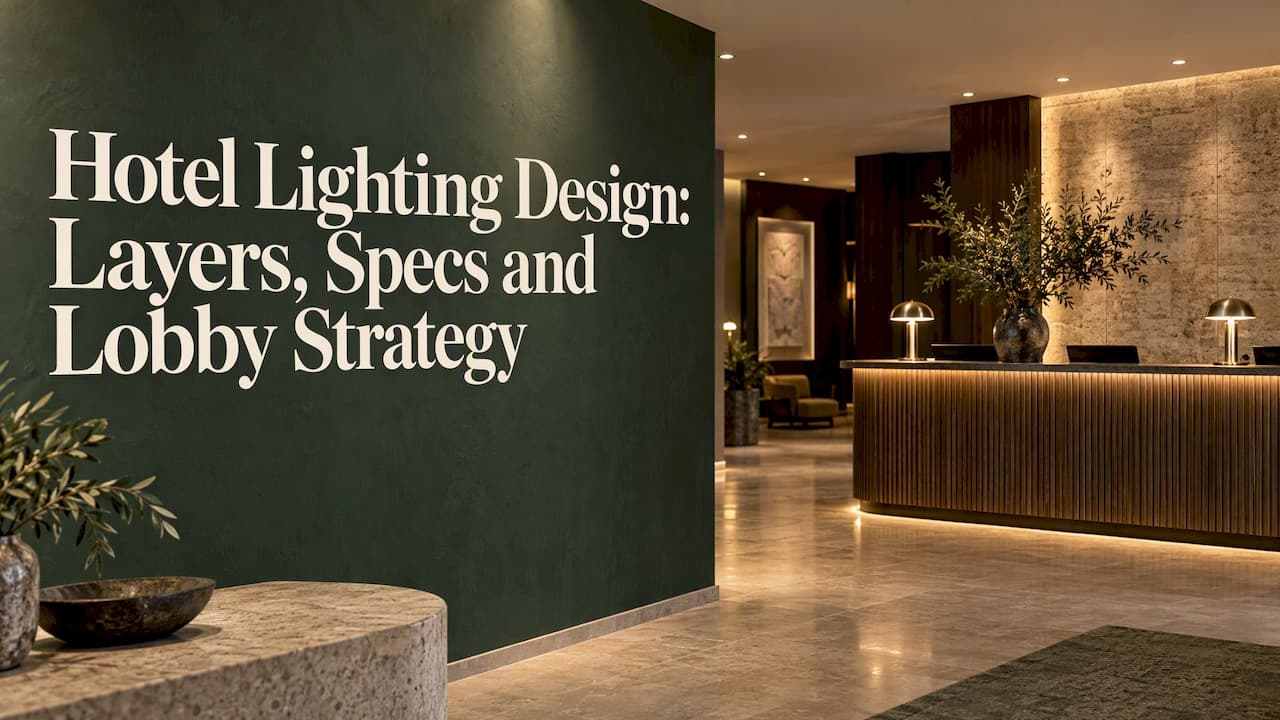
Good hotel lighting design starts with a simple rule: light every zone for what the guest is doing there, then let controls change the mood through the day. Fixtures come last. Zoning, layers, color quality, dimming and serviceability come first, and they decide whether a property feels like four stars or five.
This guide is for owners, operators and developers who are about to brief a lighting scheme. It covers the lobby, guestrooms and bathrooms, the numbers worth putting in a specification, the 2024 energy code, and the procurement mistakes that show up only after opening.
TL;DR
- Design in three layers (ambient, task, accent) and give every zone its own circuit and dimming scene.
- For upscale properties, a common specification baseline is CRI of 90 or higher, R9 of 50 or higher and SDCM of 3 or lower.
- Treat the lobby as six to eight lighting decisions, not one, and stage brightness from the entrance inward instead of turning everything up.
- Confirm driver and dimming compatibility early, and put drivers where staff can reach them.
- Buy lighting inside the FF&E process, with samples approved under final on-site light.
Table of Contents
- Why lighting is a guest-experience decision, not decoration
- The three layers every zone needs
- Lobby lighting: stage it, don't just brighten it
- Guestroom lighting: control without effort
- Bathrooms: where color quality shows
- Numbers worth putting in the specification
- Controls, drivers and the failure that appears after opening
- Energy code: guestroom shutoff is now mandatory in many projects
- Custom fixtures: where to spend, where to repeat
- A perspective from the studio
- How we can help with your hotel lighting
- Common mistakes to avoid
- FAQ
- Sources
Why lighting is a guest-experience decision, not decoration
Guests rarely say "the lighting was good." They say the room felt calm, the lobby felt welcoming, the bathroom mirror was easy to use. Lighting produces those impressions quietly, which is also why it is often cut first when budgets tighten.
There is measurable evidence behind the effect. A 2026 report on human-centric lighting in hospitality [found that guest comfort in small lodging spaces depends more on color temperature than on raw illuminance], and that dimmable controls, glare reduction and the balance of daylight and electric light all shape well-being. An earlier study of a capsule hotel reached a related conclusion:[perceived brightness depended on whether guests were reading or resting]. In other words, one fixed light level cannot serve a guest who arrives at 6 p.m., reads at 10 p.m. and wakes at 5 a.m.
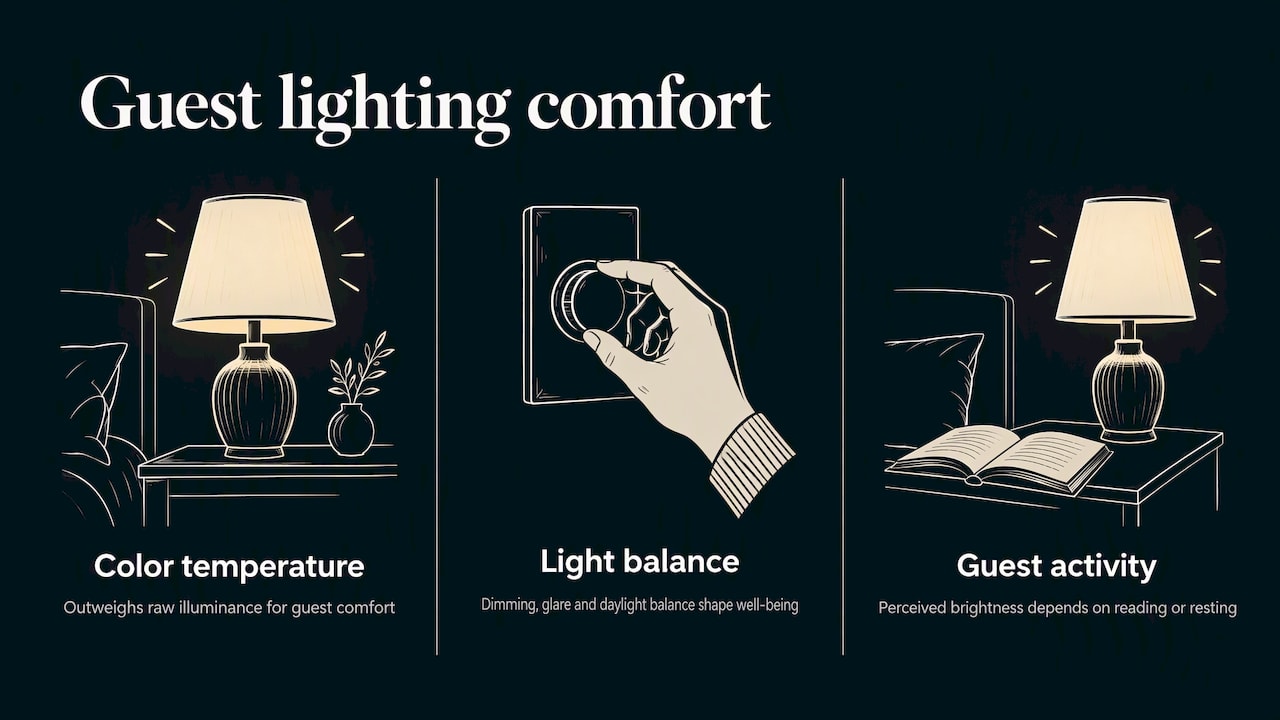
The practical consequence: design lighting as a wellness and comfort tool, and judge it by how it behaves across a day, not by how it looks in a daytime render.
The three layers every zone needs
Most professional guides,including [this 2025 hotel lighting specification guide], build schemes from the same three layers:
| Layer | Job | Typical hotel examples |
|---|---|---|
| Ambient | Base illumination and orientation | Recessed downlights, ceiling fixtures, cove lighting |
| Task | Supports an activity | Bedside reading lights, desk lamps, vanity mirror lighting |
| Accent | Highlights art, texture, architecture | Wall washers, picture lights, niche and shelf lighting |
The mistake is to deliver one layer well and skip the others. A room lit only by ceiling downlights looks flat and clinical. A lobby lit only by decorative pendants looks beautiful in photographs and fails at the reception desk, where staff need to read screens and guests need to sign.
Give each layer its own control channel. That is what lets a front-desk team move a lobby from bright morning check-out to a low evening mood with one touch, without anyone climbing a ladder.
Lobby lighting: stage it, don't just brighten it
The lobby is the hardest space in the building. It meets daylight at the door, hosts arrivals, waiting, working, drinking and walking through, and it must look the same in the brand photographs and at 2 a.m.
A specifier's guide to lobbies makes the point that a lobby is never one lighting decision but six to eight,[so you should draw the zones before choosing a fixture]. Typical zones are:
- Entrance threshold and canopy
- Reception desk
- Main circulation floor
- Lounge or seating groups
- Bar or café edge
- Feature walls, art and signature pieces
- Elevator lobby and wayfinding
Avoid the brightness trap
The same source describes a common failure: designers see the contrast between bright exterior daylight and the interior and try to fix it by increasing light levels everywhere. The result is glare, wasted energy and a lobby that feels like a retail space. A better approach is a staged brightness sequence, from threshold to general floor to task zones, connected by controls that follow the dusk-to-day cycle so transitions feel natural.
In practice that means:
- The entrance is the brightest transition zone in daytime and softens as guests move inward.
- The reception desk gets enough task light to work, with the surrounding floor kept lower so the desk reads as a destination.
- Seating groups sit at warmer, lower levels than circulation paths.
- Accent light on art and textures carries the atmosphere in the evening, when general light can drop.
Never put opposing zones on one circuit
The most common specification error in the same guide is putting two zones with opposite needs on the same control. A bar that should dim at 9 p.m. and a reception desk that must stay readable cannot share a dimmer. Zone first, then assign circuits.
Guestroom lighting: control without effort
A guestroom is a small space used for sleeping, working, dressing and relaxing. Light should be available the moment the guest enters, the room number should be clear and lit at the door, and controls should be obvious in the dark.
A few principles hold up across property types:
- Scenes over switches. An arrival scene, a reading scene, a relax scene and a night path to the bathroom beat a wall of unlabeled rocker switches.
- Bedside control. Guests should be able to turn everything off without leaving the bed.
- Warm in the evening, brighter in the morning. Color temperature that shifts with the time of day supports both comfort and sleep. The research above shows that in small rooms, color temperature affects perceived comfort more than raw brightness.
- Glare management. Position fixtures so they are not visible as bright points from the pillow.
The branding side matters too. A recent industry piece on [lighting as a brand experience] is not something we rely on here, but the principle is sound: a guest should feel the identity of the hotel in how a room responds to them.
Bathrooms: where color quality shows
Bathrooms are where poor color rendering gets noticed first. Guests apply makeup, shave and check their appearance at the mirror, and a cheap LED that makes skin look gray becomes a review comment.
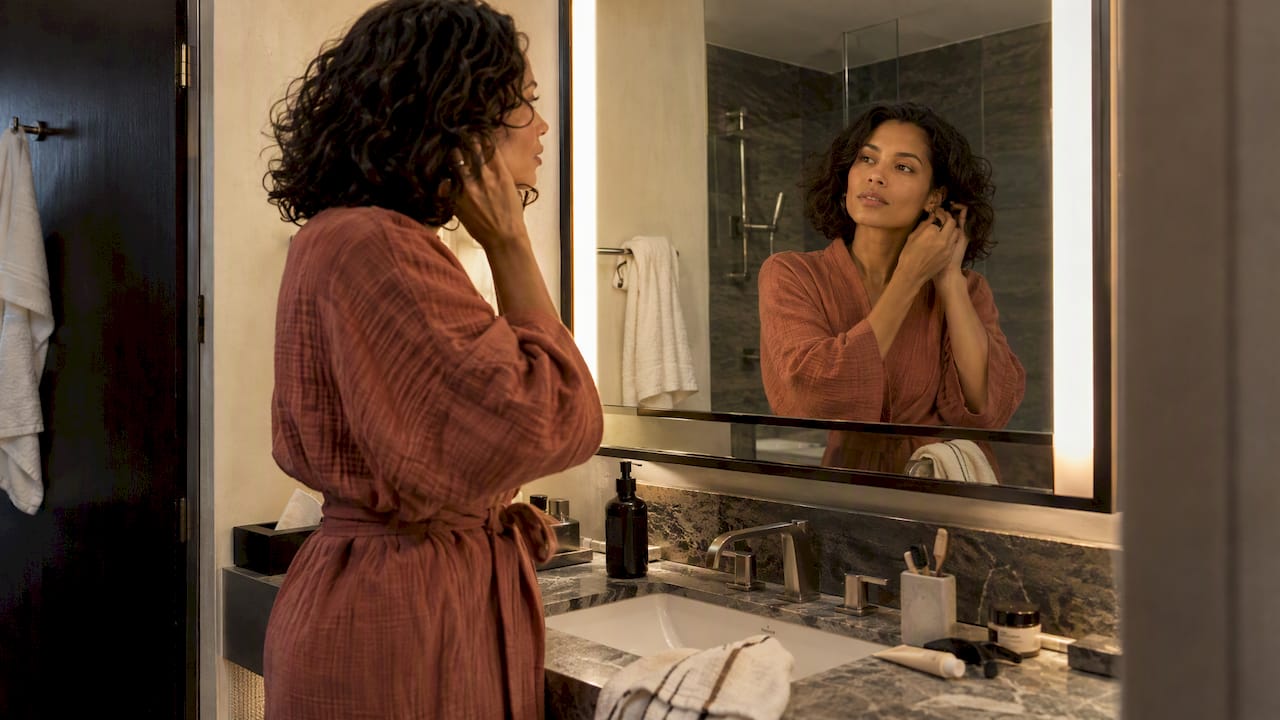
Light the face from the sides or around the mirror, not only from above, and keep the morning and night modes distinct. A bright, neutral setting suits grooming. A low, warm night light suits a 3 a.m. visit without waking a partner. Our own thinking on materials,fixtures and repairability is in our piece on [hotel bathroom design that lasts].
Numbers worth putting in the specification
Taste is subjective, but specifications can be exact. For upscale hotels, a 2025 specification guide gives these baselines: CRI of Ra 90 or higher, R9 of 50 or higher,[and SDCM of 3 or lower].
| Spec | What it protects | Why a hotel should care |
|---|---|---|
| CRI Ra ≥ 90 | General color accuracy | Skin, food, wood and fabrics look as designed |
| R9 ≥ 50 | Saturated reds | Skin tones, wine, leather and warm woods |
| SDCM ≤ 3 | Color consistency between fixtures | No visible color shifts along a corridor or across a ceiling |
These are a sensible starting point, not a law. Budget-segment properties may choose differently, and the right numbers depend on brand level and space. What matters is that the specification states them, so substitutions can be checked rather than argued about.
Also ask for photometric intent: where do you want glow, and where do you want a clean wash of light on a surface? A fixture that looks right in a catalog can throw the wrong pattern onto a wall.
Controls, drivers and the failure that appears after opening
The most common failure point in high-end hospitality lighting is not the fixture. It is the interface between drivers and dimming. One specification guide for lobbies advises that designers [verify compatibility between drivers and control protocols such as DALI and 0-10V long before installation]. Flicker at low levels, dimming that jumps instead of fades, and fixtures that will not turn fully off are all symptoms of a mismatch found too late.
The same guidance recommends a clear serviceability strategy. Drivers belong in accessible panels, not buried in ceiling voids, because replacing a failed driver above a finished ceiling in an occupied hotel is expensive and disruptive.
A short checklist to include in the brief:
- Define the dimming system (DALI, 0-10V or another protocol) at concept stage, not at tender.
- Require manufacturers to confirm driver and control compatibility in writing.
- Locate drivers and control gear in accessible panels, and show them on drawings.
- Test dimming curves on a mockup room before ordering the full quantity.
- Commission every scene on site, and hand over a simple scene list to the operations team.
Energy code: guestroom shutoff is now mandatory in many projects
If you build or renovate in the United States, check which energy code your jurisdiction has adopted. Under the 2024 IECC,[guestroom controls must automatically turn off all lights and switched receptacles within 20 minutes of the room becoming vacant]. Adoption varies by state and city, so confirm with your local authority and your engineer before you finalize the control design.
This matters creatively as well as legally. A vacancy-sensing system will interact with your scenes, your night path and your housekeeping routines. Design them together, so that a housekeeper working in a dim room does not trigger a shutoff mid-clean.
Custom fixtures: where to spend, where to repeat
Signature lobby pieces make a hotel memorable,and they are also where budgets and schedules break. Industry guidance suggests that the best projects [use custom pieces for a few focal points and combine them with high-quality repeatable families]. That prevents the value-engineering compromises and field improvisation that follow when a design is forced into catalog-only solutions.
Two protections are worth building in:
- Finish approval under real light. "Finish drift," where delivered fixtures differ slightly in tone or texture from the approved sample, can undermine an otherwise strong interior. Approve finish samples under the final on-site lighting conditions.
- Prototype for complex pieces. Ask for a mockup of any large or intricate lobby fixture before full production.
The guide also describes a staged documentation trail, from concept and budget through shop drawings and prototypes to production and site commissioning. That is the right way to think about it: lighting belongs inside the broader furniture,fixtures and equipment cycle. Our note on [budgeting FF&E for hotel owners] explains why the installed cost can run well above the ex-works price.
A perspective from the studio
We design hotel and restaurant interiors, and lighting is the layer we try to resolve earliest, because it touches everything else. A ceiling cannot be finalized without knowing where light comes from. A material cannot be approved without seeing it under the light it will live in. A guest corridor is only as good as the transition it creates between lobby and room.
Three habits come from that way of working:
- Light follows the brand story. A lobby for a family resort and a lobby for a boutique city hotel need different brightness, color temperature and contrast, even if the floor plans match.
- Lighting is drawn, not just chosen. Zones, circuits, scenes and driver locations belong on the drawings that contractors build from. When they stay in a mood board, they become site improvisation.
- Review on site. We follow projects through suppliers and installation, because the real test of a scheme is whether the delivered fixtures and settings match what was approved.
The corridor is a good example of a space where this matters. It is long, repetitive and easy to treat as leftover space,yet it is the guest's first impression of the floor. We cover those decisions in our guide to [hotel corridor design].
— slava
How we can help with your hotel lighting
Lighting works best when it is part of one design process rather than a separate package arriving late. Our service line covers [preliminary design] for concept and atmosphere,[3D interior visualization] so you can judge light and material before anything is built,[execution drawings] that put zones and fixture positions on paper,and [site and supplier follow-up] to check that what arrives matches what you approved. If you are planning a new hotel or a refurbishment,[see our services]or look at the [Zatoka family hotel project] for an example of our hospitality work.
Common mistakes to avoid
- Choosing fixtures before zones. Decide what each area does, then pick hardware.
- One color temperature everywhere. Mixed warm and cool light without intent looks accidental.
- Ignoring daylight. Lobbies change completely between noon and night; control the transition.
- Late controls decisions. Dimming protocols chosen at tender lead to compatibility problems at commissioning.
- Hidden serviceability. If staff cannot reach a driver without a lift or ceiling demolition, maintenance will wait until something fails.
- Approving finishes under showroom light. Check them where they will hang.
FAQ
What is hotel lighting design?
It is the planning of every light source and control in a hotel so that each space supports its function and the brand's atmosphere. It covers layers of light, color quality, dimming, scenes, energy compliance and maintenance, not only the choice of decorative fixtures.
How should a hotel lobby be lit?
Divide it into zones such as entrance, reception, circulation, seating and feature walls, and give each its own circuit. Stage brightness from the entrance inward and tie it to daylight with controls, instead of simply raising light levels to compete with the outdoors.
What color temperature is best for hotel rooms?
There is no single answer, but research suggests color temperature influences comfort in small rooms more than brightness does. A common approach is warmer light in the evening and brighter, more neutral light for morning and grooming, with guest-controlled scenes.
Does the energy code affect hotel lighting?
Yes. The 2024 IECC requires guestroom lights and switched receptacles to turn off automatically within 20 minutes of vacancy. Which edition applies depends on your state or city, so check with the local authority and your engineer.
When should lighting be brought into the project?
At concept stage. Lighting affects ceilings, materials, electrical layout and budget, and fixing it late tends to mean compromises or field changes.
Sources
- [Human-Centric Lighting Proves Its Value in Hospitality]
- [The effect of illuminance and correlated colour temperature on perceived comfort in a capsule hotel]
- Hotel Lighting: A 2025 Spec Guide for Rooms, Lobbies,[and Bathrooms]
- Hotel Lobby Lighting Design:[A Specifier's Guide]
- [What Contractors Should Know About the 2024-2025 IECC] - Custom Hospitality Lighting:[A Specifier's Guide]