Faux Leather vs Leather: How to Choose for Hospitality Interiors
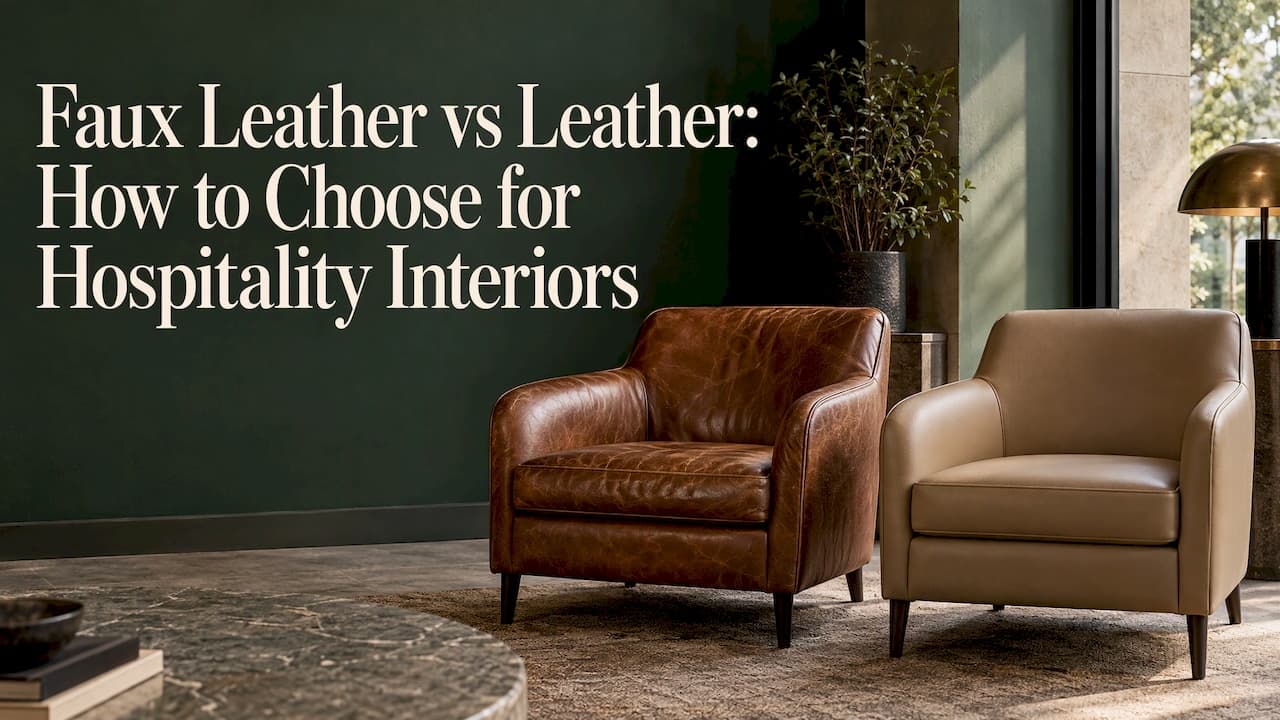
For a hotel or restaurant, the choice between faux leather and leather is not a question of which is better. It is a question of which fits each zone of the space. Real leather suits seating where guests linger, touch and sit for a long time, and where the brand story calls for it. A well-specified faux (PU) leather suits surfaces that are cleaned hard and often. The mistake is choosing one material for the whole venue from a sample swatch. The right choice comes from the brief: traffic, cleaning routine, atmosphere and budget over the life of the piece.
TL;DR
- "Faux leather", "PU leather", "bonded leather" and "genuine leather" are different products, and the last name is often misleading. Know which one a quote actually lists.
- Leather breathes and ages into a patina. Faux leather is a plastic coating on a textile, so it does not breathe the same way, and it is made for easy wiping.
- Choose by zone: banquettes and bar stools make different demands than lobby armchairs or headboards.
- Compare cost per year of service, not price per square meter. The ranking changes with how long the piece stays in the space.
- A material is part of the design concept. Settle it before the furniture is ordered, with the supplier and site follow-up in the same plan.
Table of Contents
- What the names actually mean
- Look, feel and breathability
- How each material ages
- Side-by-side summary
- Choose by zone, not by venue
- Cost over the life of the piece
- Environmental impact
- Questions to settle before you order
- Getting the material right in your project
- FAQ
- Sources
What the names actually mean
Buyers lose the most money on vocabulary,so start there. Canada's Competition Bureau published a [cheat sheet on the types of "leather" in furniture] that sorts the terms clearly:
- Full-grain leather is the outer layer of the hide, which keeps its natural grain.
- "Genuine leather" is a general term that usually describes leather that is not top or full grain. In many cases it is split leather, the lower layer of the hide.
- Bi-cast or PU leather is split leather with a polyurethane layer applied and embossed to look like top grain.
- Bonded (reconstituted) leather is made from shredded leather fibers held together with polyurethane or latex.
- Faux leather is entirely man-made from synthetic materials such as plastic. It is also sold as pleather.
So the phrase "PU leather vs genuine leather" can mean two things. It can be a polyurethane-coated textile set against a hide, or a polyurethane-surfaced split hide set against a full-grain hide. Ask which one is on the spec sheet.
Academic work describes the synthetic side in the same way. A [2021 comparison of leather and alternative materials] reports that these products usually consist of a textile support covered by two or more polymer layers, often polyester coated with PVC or polyurethane. That makes them fully fossil-based. The same paper notes that the market terms (artificial, synthetic, leatherette, imitation, faux, pleather, PU leather) are restricted in the European standard EN 15987. Names on a US quote may not follow any such rule, so the material description matters more than the label.
Look, feel and breathability
Guests read a material in seconds, before they read anything else in the room.
Look. Full-grain leather shows irregular pores, small marks and variation from hide to hide. Faux leather carries a stamped grain that repeats evenly. That uniformity is useful when you need identical covering across hundreds of chairs. It is a drawback when the concept depends on a handmade, lived-in feel.
Touch and comfort. Comfort in use depends heavily on moisture. A study by the German leather research institute FILK,[published by Leather UK], measured water vapor permeability of 4.6 mg/(cm²·h) for leather against a minimum standard of 2. It found that plastic-based substitutes hardly reached any values. The study's experts conclude that technical progress has made some properties of substitutes similar "here and there", but that no substitute matches leather across the board, especially on the moisture behavior that drives comfort in use. In practice, a guest who sits for two hours at a dinner banquette or in a lounge chair feels the difference more than one who perches at a bar for twenty minutes.
Engineering is closing some gaps. A [2023 review in Collagen & Leather] notes that polyurethane is the most commonly used plastic in leather manufacturing, as a bonding agent and coating layer. It also says that matching the flexibility, strength, abrasion resistance and breathability of genuine leather remains the main research challenge for synthetic leather. The category is improving, but the gap is still the thing to design around.
How each material ages
Leather and faux leather do not just last for different lengths of time. They age differently, and that changes how a space looks in year three.
- Leather softens, darkens and develops a patina. Marks and scuffs often read as character, which suits a bar, a library lounge or a steakhouse.
- Faux leather keeps a clean, uniform surface until the coating fails. Then it cracks, flakes or peels, and that damage cannot be rubbed out or repaired convincingly. In a hotel, worn faux leather looks neglected rather than aged.
The FILK study also points to longevity as an area where leather leads, based on flex and tear resistance tests. Service life in a real venue, though, depends on the grade of material, the zone, the cleaning chemicals and the climate. Two pieces of "PU leather" can be very different products: a contract-grade covering with a thick, well-bonded coating and a thin economy sheet are not the same thing, even when the swatches look alike. This is why a quote that says only "eco-leather" or "PU leather" tells you almost nothing about the years you will get.
Side-by-side summary
| Criterion | Full-grain or protected leather | Contract-grade faux (PU or similar) |
|---|---|---|
| Composition | Natural hide, finished | Textile base with polymer coating |
| Surface | Natural, irregular grain | Even, repeated embossed grain |
| Breathability | High, through natural pores | Low |
| Ageing | Patina, softens | Stays uniform, then cracks or peels |
| Cleaning | Gentle, material-matched care | Wipe-clean, more tolerant of frequent cleaning |
| Repair | Can be refinished and reconditioned | Coating damage cannot be rebuilt |
| Best fit | Lounges, lobbies, premium dining, headboards | Banquettes, bar stools, high-turnover seating |
The cleaning row deserves a note. Faux and vinyl upholstery are engineered to tolerate more frequent, robust cleaning than natural leather. Over-cleaning leather can strip its oils and leave the finish flat or uneven. That is why restaurants with fast table turns lean toward synthetic coverings, while hotel lounges with lower-volume, high-touch seating lean toward leather.
Choose by zone, not by venue
The practical method is to split the interior into zones and write down what each one demands.
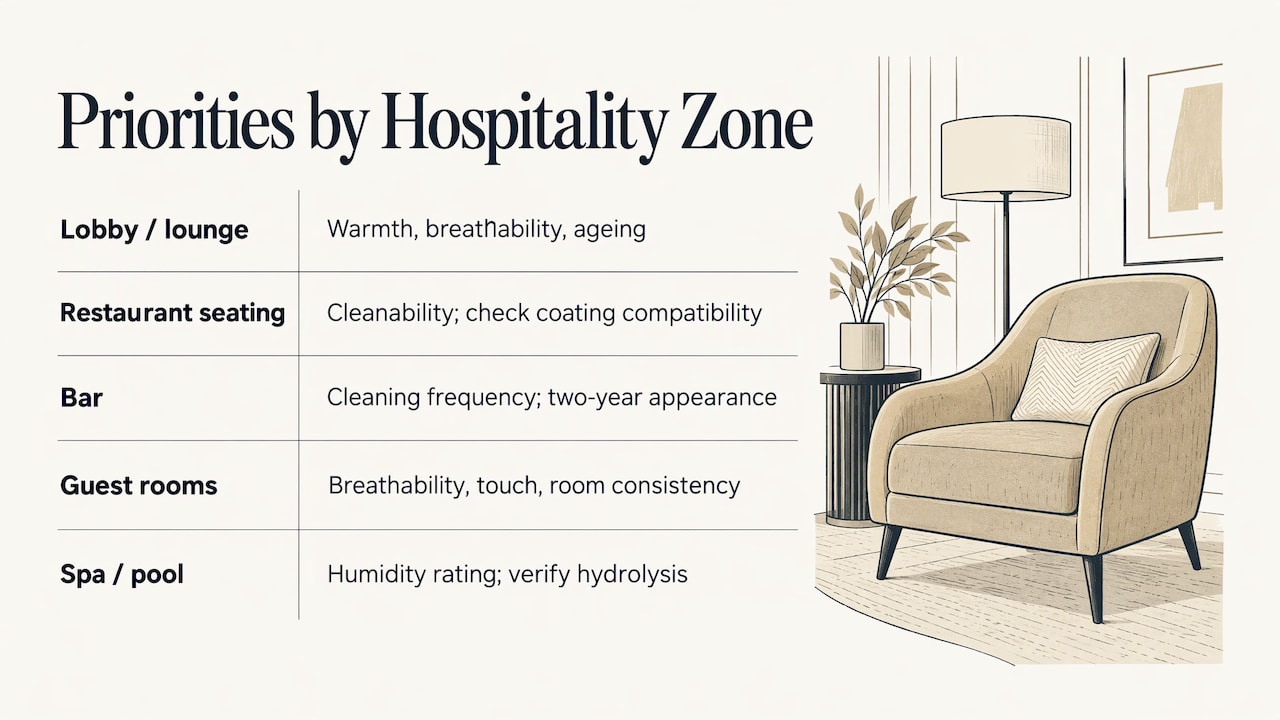
Hotel lobby and lounge. Guests sit here, wait here and judge the hotel here. Leather's warmth, breathability and ageing carry the first impression. Where the piece is a feature armchair or sofa,leather is a natural fit. Our guide to [hotel lobby design] covers how furniture, layout and renovation decisions interact in this space.
Restaurant banquettes and chairs. These take spills, sauces, cleaning sprays and constant sliding. Cleanability is the first criterion, and it cannot be proved by an abrasion number alone. We cover this in why 30,[000 rubs will not prove cleanability]. A coated synthetic often serves here, provided the coating and the cleaning products have been checked against each other.
Bar stools and counters. Constant contact with hands, clothing and drinks. Either material can work. The deciding factors are cleaning frequency and how the surface should look after two years of use.
Guest room headboards and chairs. Lower wear, but long contact with skin. Breathability and touch matter, and so does consistency across a hundred rooms.
Spa, pool and humid areas. Moisture and heat are the enemy of polyurethane coatings, so the covering must be specified for the humidity it will see. Ask for evidence of hydrolysis performance, not just a coating description.
Write the zone decisions into one specification: material reference, color, finish and cleaning protocol. Venue teams then follow a single plan instead of improvising their own cleaning habits, which is how finishes get damaged.
Cost over the life of the piece
Faux leather is cheaper to buy. That is the most repeated fact in this comparison and also the least useful on its own. The better question is cost per year in service, including re-covering and downtime.
A simple way to think about it:
- Estimate how long the piece will stay in the space before the next refurbishment. A concept meant to be refreshed in three to four years rewards a cheaper, replaceable covering.
- For a piece you expect to keep for a decade or more, such as a lobby sofa, a longer-lived material can cost less per year even at a higher purchase price.
- Add the hidden items: re-upholstery labor, closed seats or rooms during replacement, and matching a dye lot years later.
Procurement writers on the supply side reach the same conclusion. A [cost-controller analysis of real leather against polyurethane] says the comparison flips with the product lifecycle: for a three-year lifecycle, PU can have lower total cost, while for a ten-year product such as a high-end sofa, real leather wins on longevity if maintained. Treat that as a framework rather than a price list, because prices per square meter shift with the market.
This is also where the wider budget matters. Furniture is only part of the installed cost of a hotel,and our guide to [FF&E budgeting for hotel owners] explains why the installed cost runs well above the catalog price. For a broader view of how long-lasting materials change the economics of premium interiors,see this piece on [premium interior longevity and replacement].
Environmental impact
Guests and certification schemes increasingly ask about this, and the answer is less one-sided than many articles suggest.
A [comparative life cycle assessment from KTH] found that bovine leather had the highest impact of the three materials it studied, at 21.0 kg CO2 equivalent for global warming potential, against 9.0 for PU leather. The leather burden came mainly from carbon footprint, toxicity potential and water use. PU's burden came from fossil-based raw materials and energy-intensive production. The Nature Sustainability paper on fungal leather, citing the Higg Materials Sustainability Index,reports that [synthetic leather scores about a quarter of the impact of bovine leather], though abiotic resource depletion is nearly equal for the two.
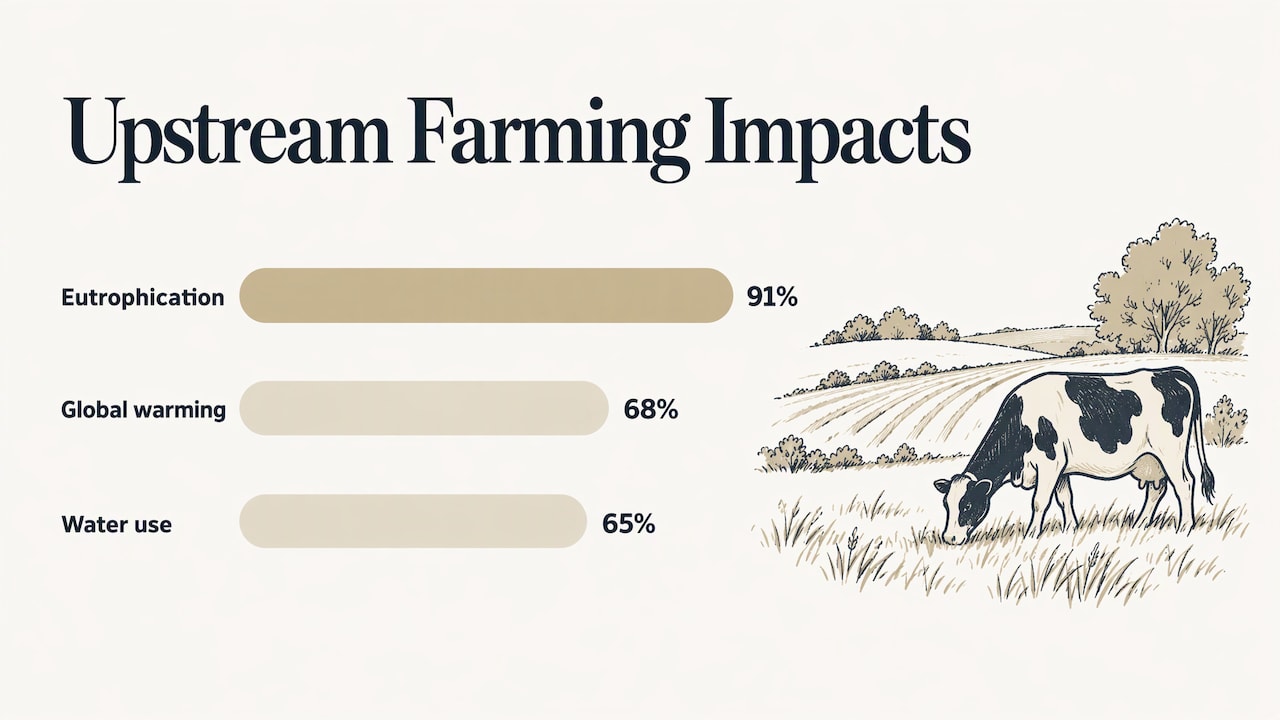
Where does the leather impact come from? A 2025 global LCA of the cow leather industry covered 56 studies across 16 facilities in 11 countries. It found that farming, the upstream stage, drives most of the footprint: 91% of eutrophication, 68% of global warming potential and 65% of water use. So the sourcing of the hide, and the fact that it is a by-product of the food chain, matters as much as the tannery.
The practical reading for a project team: the lowest-impact choice is the one that stays in service and avoids early replacement, since replacing a material has its own footprint. If you pursue a green certification,material choices feed into it. Our comparison of [LEED vs BREEAM for hospitality projects] shows how to plan for it. For a guest-facing perspective on sustainable stays,there is also a good overview of [eco-friendly hotel choices].
Questions to settle before you order
Before signing off any covering, leather or synthetic, get these answers in writing:
- What exactly is the material: full-grain, corrected-grain, split with a PU layer, bonded, or a coated textile?
- Which abrasion method was used? Martindale and Wyzenbeek are different tests and cannot be converted into each other.
- What cleaning products will staff use, and has the supplier approved them for this finish?
- For humid zones, what hydrolysis resistance is declared?
- What are the fire requirements for your jurisdiction, and is the certificate for the exact build-up you are ordering?
- Will the same material, color and dye lot be available when pieces need replacing?
A higher abrasion result is not a guarantee of calendar life, so these answers matter more than any single number.
Our view as designers
We design hospitality interiors, and in our work the leather question is almost never about leather. It is about what the room has to do. A restaurant that turns tables four times a night and a hotel lounge that guests sink into after a long flight need different surfaces, and both should still feel like the same brand.
That is why we treat material choice as part of the concept, not a purchasing detail. The finish, the grain, the way a seat looks after a year of use and the way staff will clean it all shape the guest's experience. They are decided together with the layout, lighting and furniture, and then written into the drawings so that nobody on site has to guess.
Our approach is bespoke and specific to the client and the context. We would rather specify two or three materials well, zone by zone, than apply one fashionable covering everywhere. And we stay with the project through suppliers and site, so what was specified is what arrives.
slava
Getting the material right in your project
If you are planning a restaurant, hotel or commercial space and want the upholstery decision made as part of a complete design, our furniture,[materials and accessories service]covers the selection of furniture and finishes for the concept. It continues through [site and supplier follow-up],so the specified materials are the ones installed. You can also look at the full range on our [services page].
The specification itself lives in the technical package,and the guide to [what a hospitality drawing set includes] shows where material references and finishes are recorded.
FAQ
Is faux leather the same as PU leather?
Not always. "Faux leather" is the broad term for man-made imitations, and PU is one common type, made of a polyurethane coating on a textile. PVC is the other common coating. The label "PU leather" is also used for split leather with a polyurethane layer, so check the material description on the spec sheet.
Does genuine leather mean the best leather?
No. Per the Competition Bureau of Canada, "genuine leather" is a general term that usually describes leather that is not top or full grain, and it is often split leather. Full-grain leather retains the natural grain of the outer layer of the hide and is the term to look for when you want the top grade.
Which is better for restaurant seating?
It depends on the zone and the cleaning routine. Banquettes and high-turnover seats usually need a surface that tolerates frequent, robust cleaning, which is where a contract-grade synthetic is designed to perform. Premium dining rooms with a slower pace and a strong brand story can carry leather well. Match the material to the zone and to the cleaning products your staff will really use.
Is leather or faux leather more sustainable?
It depends on what is measured. In the KTH life cycle assessment, bovine leather had a higher carbon footprint than PU leather, while PU depends on fossil-based materials. Both results favor a choice that stays in service for its full planned life rather than being replaced early.
Sources
- Cheat sheet: types of "leather" in furniture,[Competition Bureau Canada]
- Comparison of the technical performance of leather and alternative materials,[MDPI]
- Leather: Often copied, never equalled,[FILK study via Leather UK]
- Recent advances concerning polyurethane in leather,[Collagen & Leather]
- Cost controller's view:[real leather vs polyurethane]
- Life cycle assessment of leather and leather-like materials,[KTH]
- Leather-like material biofabrication using fungi,[Nature Sustainability]