Veneer vs Laminate: How to Choose for Cabinets and Commercial Interiors
Veneer is a thin slice of real wood glued to a panel. Laminate is a manufactured surface of printed paper and resin, bonded to a panel. Choose veneer when authentic grain and a warm, furniture-like look matter most. Choose laminate when the surface will take heavy daily use, spills and cleaning, and when budget and consistency across many units matter. The right answer often differs from one surface to the next within the same space.
This guide is written for people who specify interiors: hotel owners, restaurant operators, developers and property managers. It also holds up for anyone comparing laminate vs veneer cabinets for a kitchen.
TL;DR
- Veneer is real wood on a stable core. It gives true grain and color variation, and it can be refinished, but it needs protection from moisture and heat.
- Laminate is a printed, resin-sealed surface. It resists wear, stains and water on its face and is easier to clean, but it is a pattern, not wood.
- Cost usually favors laminate. One industry study of commercial interiors found savings of up to 37% for high-pressure laminate versus wood veneer.
- Edges and seams decide how both materials age. Moisture that reaches the core is the most common reason either one fails.
- In hospitality, mix them by zone: veneer where guests look and touch gently, laminate where hands, trays and cleaning crews work hardest.
Table of Contents
- What veneer and laminate actually are
- Appearance and feel
- Durability, moisture and care
- Cost: what the numbers show
- Which is better for cabinets?
- Veneer vs laminate in hotels and restaurants
- How to choose: five questions
- Mistakes to avoid when specifying
- Our perspective
- How we help with material decisions
- FAQ
- Sources
What veneer and laminate actually are
The two names get swapped constantly, but the materials are built differently.
Wood veneer is a thin layer of real wood,pressed onto a base such as plywood or MDF. [Architectural Digest India describes veneers] as thin wood layers pressed onto plywood, which is the construction you will see in most architectural joinery. Because it is cut from a real tree, every sheet has its own grain, figure and tonal shift.
Laminate contains no wood surface at all. The same source explains that laminates are layers of paper and plastic resin pressed under high pressure and then applied to plywood, MDF or particleboard. The decorative layer is a printed design, so the pattern can imitate wood, stone, fabric or a solid color.
The word "laminate" covers more than one product, and this matters when you write a specification:
- **High-pressure laminate (HPL)** is made from resin-impregnated paper layers pressed under heat and pressure. A [manufacturer datasheet for HPL] describes it as decorative laminate based on melamine-impregnated paper under the EN 438-3 standard, and lists scratch, impact, heat and stain resistance test results.
- Low-pressure laminate (melamine, also called TFL or thermally fused laminate) is a thinner paper and resin surface fused directly to the panel. It is the economical choice and is common inside cabinet boxes and on shelving.
So "veneer vs laminate" really means three tiers: real wood, a tough high-pressure surface and a lighter-duty melamine surface. Treating all laminate as one product is how a good material ends up in the wrong place.
Appearance and feel
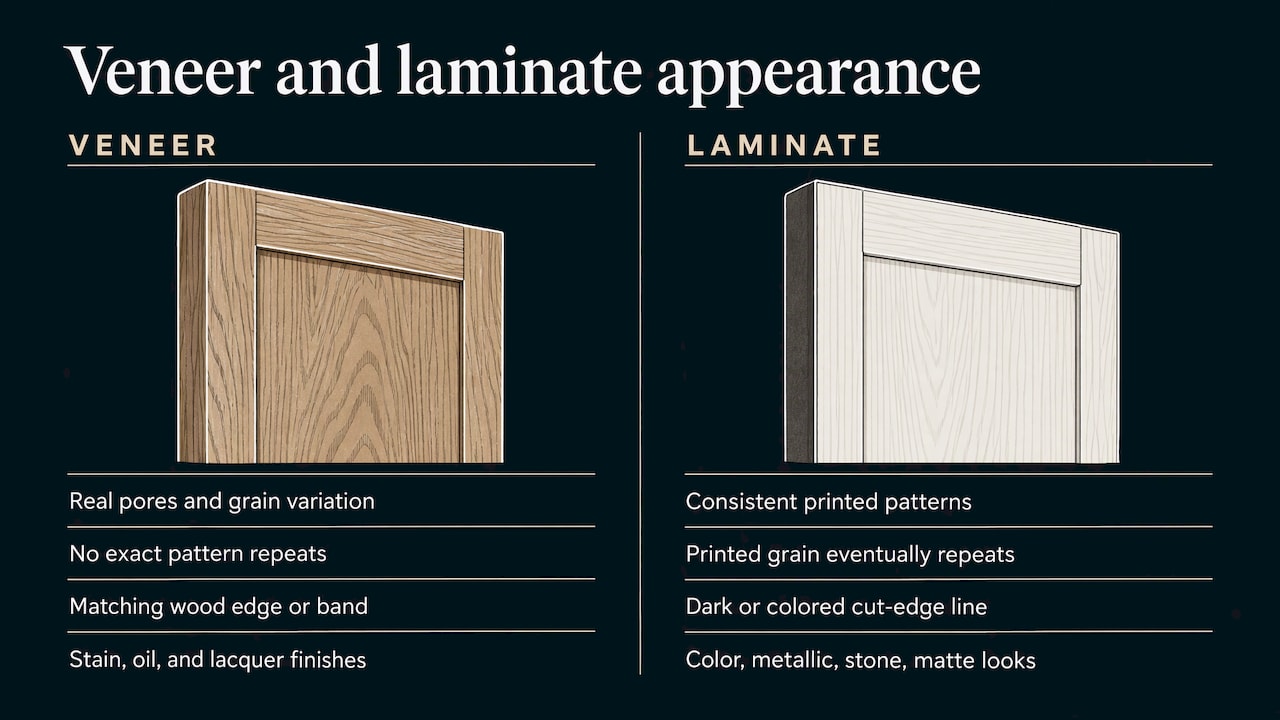
Veneer wins on authenticity. You see real pores, real variation, and light moves across the grain the way it does on solid timber. Fine veneer joinery in walnut, oak or ash also takes stain, oil and lacquer, so you can tune the tone to a palette.
Laminate wins on consistency. Every door in a 200-room hotel can match exactly, which is hard to guarantee with a natural material, where each flitch (a bundle of sequential veneer leaves cut from one log) differs from the next. Modern wood-look laminates have deep embossed textures that follow the printed grain, and some are convincing at arm's length. Laminate also reaches beyond wood: saturated colors, metallic looks, stone patterns and matte textures that are difficult to get any other way.
A practical way to see the difference on site: look for repeats. A printed pattern eventually repeats across a large surface or across several doors. Real veneer, matched carefully, does not repeat exactly. Also look at the edge. Veneer is usually finished with a matching wood edge or thin edge band, while laminate shows a thin dark or colored line at the cut unless it is matched to the decor.
Durability, moisture and care
This is where the two diverge most for working spaces.
Laminate on the face
HPL is built for abuse. [Formica describes its HPL] as hard-wearing and resistant to water, chemicals, abrasion, scratches, color fading and stains, with easy cleaning. Everyday care is simple:[Formica's care guidance] recommends a damp, nonabrasive cloth with mild detergent, rinsing without flooding the seams, and drying with a soft cloth. The same guidance warns that water near seams can swell the substrate.
That last point is the real weakness of laminate: the face is tough, but the core is not. Chipped corners, open seams and badly sealed edges let liquid reach MDF or particleboard, which swells and cannot be repaired invisibly.
Veneer and its limits
Veneer is real wood, and it behaves like wood. Architectural Digest India notes that veneer needs periodic maintenance, is not inherently waterproof and can be damaged by heat or by moisture getting beneath it. When the glue line loosens, you get bubbles or lifting.
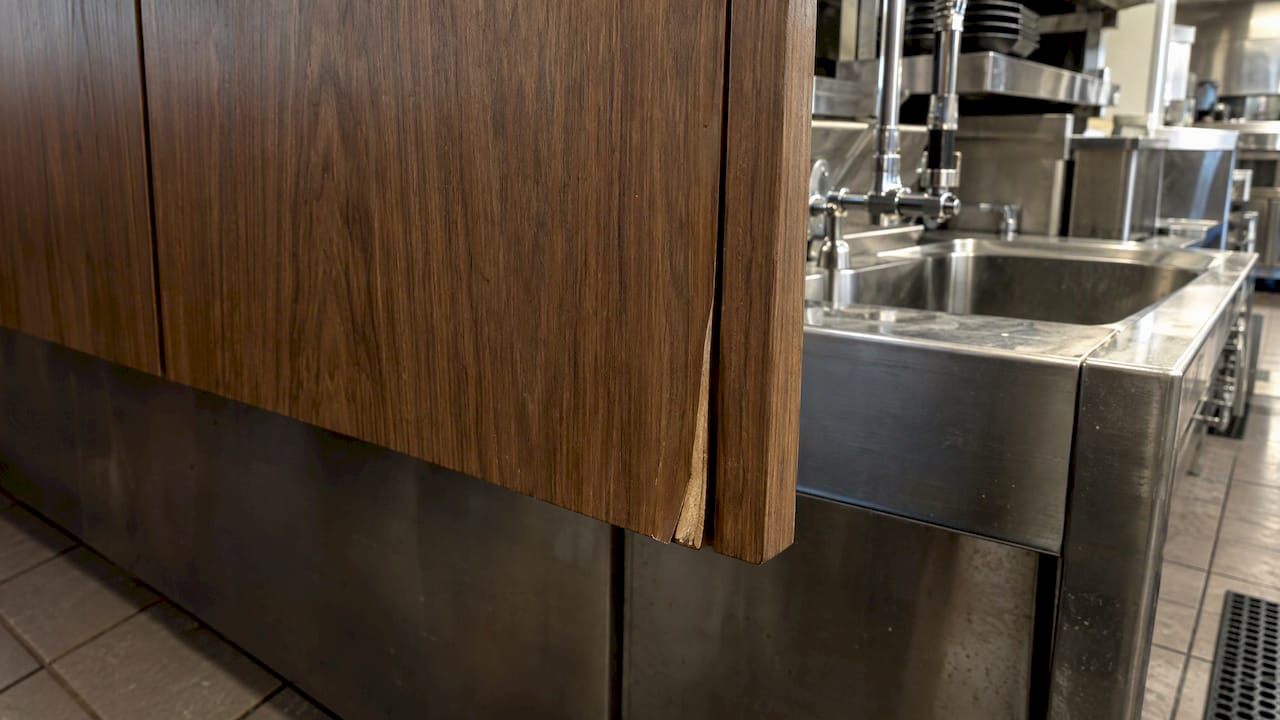
The [Australian timber veneer association's care bulletin] gives a rule that applies anywhere: seal all surfaces, including the edges and the back, to slow moisture ingress, because unsealed panels are prone to bow or cup. In practice, this means a veneered door should have the same finish on the inside as on the outside, and exposed edges should never be left raw.
There is an upside. A worn veneer surface can be lightly sanded and refinished, which a laminate cannot. For a lobby bar or a reception desk that you want to look better after five years of use, that refinishing option is valuable.
Quick comparison
| Criterion | Wood veneer | HPL laminate | Melamine (TFL) |
|---|---|---|---|
| Surface | Real wood slice | Printed paper, hard resin | Printed paper, thin resin |
| Look | Unique grain and color variation | Consistent pattern, many textures | Consistent pattern, limited texture |
| Scratch and stain resistance | Moderate, depends on finish | High | Moderate |
| Moisture | Needs sealed faces and edges | Face resists water, seams are the risk | Edges and seams are the risk |
| Repair | Can be sanded and refinished | Replace the panel | Replace the panel |
| Typical cost position | Highest | Middle | Lowest |
| Best for | Feature walls, reception, guest-facing joinery | Counters, doors, drawer fronts, high-traffic surfaces | Cabinet interiors, shelving, back-of-house |
The ratings are general characteristics. Finish, thickness, species and edge treatment move any individual product up or down the scale.
Cost: what the numbers show
In general, laminate costs less than veneer, and melamine costs less than both. But "how much less" depends on the project, and the best published evidence comes from commercial interiors rather than homes.
A study by EGGER,[reported by Woodworking Network], examined value engineering across an apartment kitchen, a bathroom, a retail store and a restaurant and bar. Its estimates showed savings of up to 79% for TFL versus wood veneer and up to 37% for HPL versus wood veneer. In the kitchen example of 450 square feet per unit, TFL gave overall savings of 37% versus HPL and 79% versus red-oak veneer, combining material and labor estimates.
Two cautions help you read those figures. They are estimates for a specific set of examples, and they come from a manufacturer of laminate panels, so treat them as a sense of scale, not a quote. And the cheapest surface is not always the cheapest outcome: a surface that needs replacing in four years can cost more than one chosen correctly the first time.
Which is better for cabinets?
For laminate vs veneer cabinets, split the question into parts, because a cabinet has more than one surface.
- Door and drawer fronts. These take the most contact. HPL is the safer choice in kitchens, bar backs and service stations. Veneer suits fronts in lower-contact settings such as wardrobes, a guest room headboard wall or a reception credenza.
- Worktops and counters. Where hot pans, cleaning chemicals and spills are routine, HPL is far more forgiving than veneer. If the brief calls for natural wood on a counter, specify a hard-wearing protective finish and plan to maintain it. For stone options,see our comparison of [quartz and granite countertops].
- Cabinet interiors and shelving. Melamine is the typical economical solution. Nobody sees it much, and it wipes clean.
- Edges. Whatever the face material, the edge is the first thing to fail. Ask for tight, well-bonded edge banding and sealed cut-outs around sinks, dishwashers and handwashing stations.
If you are asking "which is better, melamine or veneer," the answer depends on role. Melamine is for cost and cleanability in places that are used hard but not seen. Veneer is for places that must look and feel like wood.
Veneer vs laminate in hotels and restaurants
A commercial space has a different problem from a home kitchen. Surfaces are touched by hundreds of people, cleaned daily, and expected to look right for years under the operator's brand. The decision comes down to zones.
- Entrance, reception and lobby. Veneer is at its best here. Guests see it first and it reads as warmth and quality. Plan for protective finishes and a refinishing cycle.
- Bar fronts and banquettes. Both work. Veneer gives richness; HPL handles kicks, bags and glassware. Many designers put veneer on the upper, visible planes and HPL on the lower, impact-prone ones.
- Hotel guest rooms. Headboard walls and wardrobes in veneer give a residential feel, while desks, luggage benches and minibar units in HPL hold up to constant use. Repeated identical units make laminate's consistency a real advantage across a whole floor.
- Bathrooms and wet areas. Be conservative. Veneer should be kept away from direct splash,and laminate needs sealed seams. Our guide to [hotel bathroom design that lasts] covers fixtures and repairs in more detail.
- Kitchens and back-of-house. HPL and melamine are the norm. Cleanability and cost lead the decision.
- Floors. Neither veneer nor laminate sheet is the answer here. See our review of [restaurant flooring options by zone].
The same logic applies to soft finishes. Cleanability matters as much on a banquette as on a counter,which is why we wrote about [commercial upholstery fabrics].
Keeping finishes clean in busy kitchens
In restaurants, grease and humidity travel from the line into the dining room. Surfaces near the pass and the bar are exposed to airborne grease long before anyone spills anything. Regular degreasing of the kitchen's surroundings protects every finish you installed,and operators in Manitoba can look at [commercial kitchen wall cleaning] alongside hood and duct servicing. Whatever you use, keep abrasive pads and harsh solvents away from veneer and laminate alike, and follow the manufacturer's care sheet.
How to choose: five questions
- Who touches it, and how often? High-contact surfaces point to HPL. Occasional contact points to veneer.
- Will it be wet? If water or steam is routine, avoid veneer or specify a robust sealed finish. For laminate, insist on sealed seams.
- Does the brand need real wood? If authenticity is part of the guest experience, put veneer where people actually look and touch gently.
- How many identical units? Large repeating runs favor laminate for consistency and speed.
- Who will maintain it? Veneer rewards a maintenance plan. If cleaning is done by staff with a standard routine, specify materials that tolerate it.
A useful rule: spend your veneer budget where guests spend their attention, and use laminate everywhere the schedule and the cleaning chemicals are hardest.
Mistakes to avoid when specifying
- Writing "laminate" without a grade. HPL and melamine perform very differently. Name the type, thickness and standard.
- Leaving edges and backs unsealed on veneer. This is the most frequent cause of cupping.
- Ignoring seams near water. Both materials fail from the core outward when liquid gets in.
- Matching samples under the wrong light. A small sample under showroom lighting can look nothing like a full wall under warm hospitality lighting. Review materials in the real light of the space.
- Forgetting the refinishing plan. If you choose veneer for a counter or bar, decide at the start how it will be restored.
Our perspective
Veneer versus laminate is rarely a choice for a whole project. In the hospitality interiors we design, the better question is where each material earns its place. A guest sees the entrance wall, the bar front and the headboard. The hands, trays and cleaning cloths hit the counters, drawer fronts and service stations.
That is why we treat material selection as part of the concept, not a purchasing step at the end. When the idea, the visualization and the technical drawings are developed together, the edge details, the seams and the finishes are already resolved before anything is ordered. A brand's character shows up in how consistently a surface behaves after a year of service, not only on opening day.
Our approach is fully bespoke and specific to the client's brand and context. We pair real wood where it adds warmth with durable surfaces where operations demand them, and we follow the work through suppliers and on site so that what is built matches what was drawn.
slava
How we help with material decisions
If you are planning a restaurant, hotel or commercial space, choosing between veneer and laminate is one of dozens of decisions that need to be coordinated. We handle them as one process:[preliminary design] to set the concept,[3D interior visualization] so you can judge finishes before they are bought,and [execution drawings] that specify every edge and seam.

We also manage furniture,[materials and accessories]and the [site and supplier follow-up] that keeps the result true to the design. To discuss your project,start at [boom-project.com].
FAQ
Is veneer better than laminate?
Neither is better in every case. Veneer is better for authentic wood grain and can be refinished. Laminate is better for wear, stains and consistency across many units. Match the material to the zone and the use.
What are the downsides of wood veneer?
Veneer is not inherently waterproof, and moisture or heat beneath it can loosen the adhesive and cause damage. Sealing all faces and edges slows moisture ingress, and it needs periodic maintenance. With the right finish and care plan, it performs well in guest-facing areas.
Is laminate or veneer cheaper?
Laminate is generally cheaper. In an EGGER study of commercial interiors, HPL showed savings of up to 37% and TFL up to 79% compared with wood veneer. Actual costs depend on species, grade, thickness and labor.
How do I tell veneer from laminate?
Look at the grain and the edge. Real veneer has a grain that does not repeat exactly, and the edge usually shows wood or a matching band. Laminate often repeats its pattern and shows a thin colored line at the edge.
Can you repair veneer and laminate?
Veneer can be lightly sanded and refinished if the wood layer is thick enough, so work carefully. Laminate damage beyond minor filling generally means replacing the panel. Keep water away from seams on both.
Sources
- Architectural Digest India: Veneer or Laminate,[which one is better?]
- Formica:[High pressure laminate HPL sheets]
- Formica:[Laminate cleaning and maintenance]
- Swiss Krono:[High pressure laminate HPL product datasheet]
- Timber Veneer Association of Australia:[Care recommendations for veneered products]
- Woodworking Network:[EGGER study compares material impact on pricing]