Quartz vs Granite Countertops: Which Holds Up Better
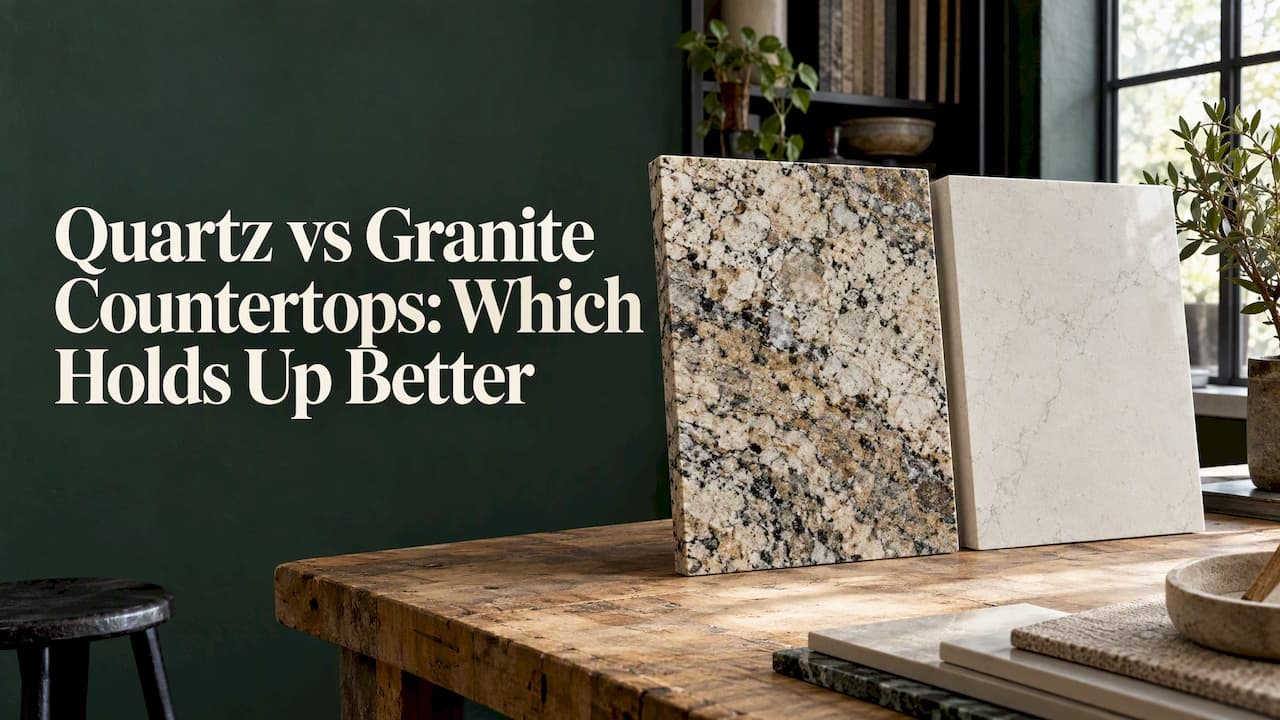
Choose quartz when you want a uniform look, no sealing and strong stain resistance. Choose granite when the surface will meet hot pans, or when you want each slab to be one of a kind. Both are excellent, and neither is a bad buy. The right one depends on what the counter will actually do all day: a home kitchen, a hotel bar or a restaurant host stand.
This guide compares the two on the points that decide the choice: how they are made, how they wear, how they handle heat, what upkeep they need, how they look, what they cost and what they mean for the environment. We design restaurants, hotels and commercial interiors, so we also cover what changes when a counter takes hundreds of guests a day instead of one family.
TL;DR
- Durability: Both rated Excellent for cutting,abrasion and heat in [Consumer Reports testing]. Either can chip if an edge takes a hard knock.
- Heat: Granite takes hot cookware better. Quartz needs trivets,because [a hot pan can crack it].
- Upkeep: Quartz never needs sealing. Granite needs periodic sealing to resist stains.
- Look: Quartz is consistent across slabs and comes in a huge range of colors. Granite is natural, so every slab differs.
- Commercial use: Both suit bars, host stands and buffet counters. Back-of-house food prep usually stays stainless steel.
Table of Contents
- What each material actually is
- Durability: how each one wears
- Heat resistance: the clearest difference
- Maintenance: sealing and cleaning
- Looks and design flexibility
- Cost: what drives the price
- Environmental and health considerations
- Commercial use: bars, host stands and food zones
- Quartz or granite: a quick comparison
- Which one to choose
- Our perspective: the counter is part of the concept
- Designing a venue? We can specify it for you
- FAQ
- Sources
What each material actually is
The two differ at the source, and nearly every other difference follows from it.
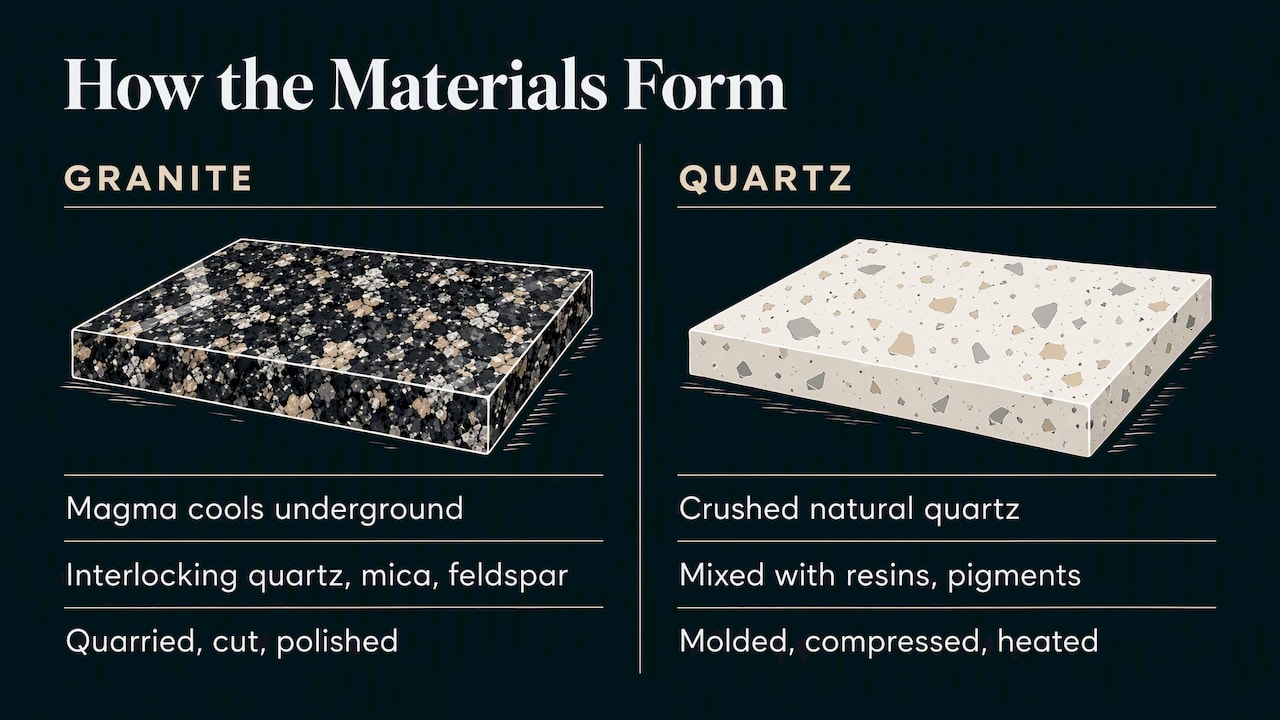
Granite is natural stone. The Worktop Fabricators Federation describes it as an [igneous rock formed when magma cools slowly underground], locking minerals such as quartz, mica and feldspar into an interlocking structure. Blocks are quarried, cut into slabs and polished. According to one supplier's FAQ,slabs come in [2 cm or 3 cm thicknesses].
Quartz is engineered stone. The same federation explains that producers crush natural quartz, mix it with resins,[polymers and pigments], then mold, compress and heat the mixture into slabs. A professional stone manual from South Africa adds that the mix can also include siliceous sands,[crushed granite and colored glass or mirror chips].
In short: granite is mostly nature's work, and quartz is a manufactured product built on natural minerals. That is why granite varies and quartz can be controlled.
Durability: how each one wears
People often assume one is far tougher. The testing says otherwise. Consumer Reports found that both materials earned Excellent ratings for cutting,[abrasion and heat], and that either can chip if an edge is hit hard. Under everyday use, neither will scratch from a knife slip or a dragged plate.
Where they separate:
- Stains. Both resisted many stains. In the same tests, quartz scored 2.3 points higher than granite for beet juice and food coloring, which matters at a bar serving red wine and berry cocktails.
- Chips and edges. Corners and thin edges are the weak point on both. A chip in granite can usually be filled and polished. Repairing a chipped or cracked quartz slab is harder, and sometimes the slab has to be replaced. That is a point to weigh for a counter that takes constant trolley and tray traffic.
- Quality spread. Natural granite varies slab to slab,with some stones more fissured than others. Quartz varies by manufacturer. A professional stone manual stresses that [quality differs between products], and that correctly made quartz is virtually non-porous. A cheap, thin or poorly made slab is the real durability risk, whichever material it is.
On durability alone, call it close to a tie. Quartz wins on stains and consistency. Granite wins on forgiveness around heat.
Heat resistance: the clearest difference
Granite formed under extreme heat, and it shows. Hot pots and pans can go straight onto it without worrying about heat damage or thermal shock,[according to HowStuffWorks]. Quartz is less heat-resistant: because it contains resin, a hot pan can crack it or leave a mark.
The professional guidance agrees on the principle. Even well-made engineered quartz [still needs protection from excessive heat]. Published temperature thresholds vary between sources and manufacturers, so follow the care sheet from the brand you buy rather than a number from a forum.
Practical rules:
- Use trivets or heat pads under anything straight off the burner, oven or a fryer on quartz.
- Do not set large, hot roasting pans or slow cookers on quartz for long periods.
- On granite, you can be more relaxed, but a trivet still protects the sealer and avoids sudden temperature shocks near seams.
If the counter sits beside a pass, a coffee station with a steaming machine or an open kitchen, this one factor often decides the choice.
Maintenance: sealing and cleaning
Quartz does not require sealing. Granite requires periodic sealing to prevent stains,as [HowStuffWorks explains]. How often depends on the stone and its finish. Some granites are dense and need it rarely. Others are more open-grained and need it more. Ask your fabricator for the schedule for the exact slab,and read the [Natural Stone Institute's care guidance] for natural stone surfaces.
Cleaning is the same for both: mild soap and warm water. Skip abrasive cleaners and acidic products such as vinegar or lemon-based sprays, which can dull a polished finish over time.
For a home, sealing once in a while is a small chore. For a hotel with dozens of counters, it becomes a line in the maintenance schedule that someone must own. If you know your team will not keep up with it, quartz is the safer choice.
Looks and design flexibility
This is where most buyers actually decide. Granite's colors come from its minerals, and each slab has its own blend of color, markings and movement,[as one design publication puts it]. Quartz offers a wide range of colors and patterns and can be matched consistently across several slabs.
The Worktop Fabricators Federation sums up the trade-off:engineered quartz gives [controlled colors and patterns through manufacturing], while granite's geology gives natural variation and individuality.
What this means in a real project:
- Long runs. A 20-foot bar or a reception desk built from several slabs looks uniform in quartz. In granite, you must choose the slabs together and plan the seams so the veining and flecks read as one piece.
- Brand consistency. A restaurant group opening several sites can reorder the same quartz pattern later. Natural stone cannot be reordered in exactly the same way, because the next block is a different rock.
- Character. If the concept relies on warmth, depth and a natural feel, granite brings what no printed or manufactured pattern fully matches.
- Reading the sample. A palm-sized sample hides a lot. For natural stone, always go and select the actual slab.
Cost: what drives the price
Published per-square-foot ranges differ widely by city, slab grade and fabricator, and they date quickly. Rather than quote one figure that may not match your market, here is what actually moves the bill, for both materials:
- Slab grade. Granite price depends on the rarity and origin of the stone. Quartz price depends on the manufacturer and collection.
- Edge profile. Simple eased edges cost less than mitered, waterfall or ogee edges.
- Layout complexity. Cutouts, curves, many seams and islands add fabrication hours.
- Thickness. 3 cm slabs usually cost more than 2 cm, and thicker slabs may need less support.
- Installation and access. Stairs, tight elevators or a fourth-floor bar cost more to deliver and fit.
The two overlap across their price ranges. Entry-level granite can undercut quartz, and exotic granite can cost more than premium quartz. Ask three fabricators to quote the same layout in both materials, with edges and seams listed, and compare the totals.
For commercial work, add the lifecycle view. Sealing labor, the cost of a repair and downtime when a counter is damaged all count over a 10-year horizon, not only the day-one price.
Environmental and health considerations
It is tempting to treat natural as greener, and the data partly supports that. For a hotel with 300 guest rooms,the Natural Stone Institute reports that [natural stone had a global warming potential of 46.8 kg CO2 eq/m²], against 102.6 kg CO2 eq/m² for engineered quartz. That figure comes from an industry body for natural stone, so read it as one useful data point, and ask manufacturers for their own environmental product declarations. Natural stone, the Institute's catalog notes,is [close to finished as a building material in its raw state], because nature does most of the manufacturing.
For quartz,check the product's documentation. Some engineered surfaces carry low-emission certification such as [GREENGUARD Gold], and a project aiming for a green building rating will want that paperwork on file. Environmental declarations also expire, so ask for the current one.
Commercial use: bars, host stands and food zones
Residential advice does not transfer directly to a restaurant or hotel. Three points to keep in mind:
- Front of house. Quartz and granite both work well for bars, host stands, buffet counters and reception desks,according to a [commercial countertop guide]. Stainless steel remains the standard for back-of-house food prep.
- Food contact. NSF/ANSI 51 is the standard for food-contact surfaces, and specific quartz brands may be certified to it. If a surface touches unwrapped food, ask for the certification of that exact product and check with your local health inspector.
- Outdoors. Granite has long been a favorite for outdoor installations, though weather can damage it,while [engineered stone is typically not considered suitable outdoors]. For a terrace bar, granite is the stronger candidate. Quartz resin can also fade under strong sun.
The counter also has to match what is around it. If you are choosing finishes for a whole venue,our guides on [restaurant flooring by zone],[commercial upholstery fabrics]and [hotel bathroom design that lasts] apply the same logic to other surfaces.
Quartz or granite: a quick comparison
| Factor | Quartz | Granite |
|---|---|---|
| Material | Engineered: crushed quartz, resin, pigments | Natural stone, quarried and polished |
| Scratch and cut resistance | Excellent in Consumer Reports tests | Excellent in Consumer Reports tests |
| Stain resistance | Non-porous, scored higher on beet juice and food coloring | Resists many stains, sealing helps |
| Heat | Use trivets, hot pans can crack it | Handles hot cookware well |
| Sealing | Not needed | Periodic sealing |
| Look | Consistent, huge color range | Unique slab to slab |
| Long runs and repeat orders | Easy to match | Needs slab selection, cannot be reordered exactly |
| Outdoors | Typically not suitable | Long used outdoors |
Which one to choose
Pick quartz if:
- You want a consistent color over a long bar, desk or island.
- Nobody will reliably seal a surface every year.
- The counter faces red wine, coffee, juice and other staining liquids.
- You plan to repeat the look in several locations.
Pick granite if:
- Hot pans, steam or a heated pass sit near the counter.
- You want a natural, one-of-a-kind character.
- The surface is outdoors or partly exposed to weather.
- You prefer a lower embodied carbon figure and accept the sealing routine.
If both fit, order a quote for each and choose on the sample, not the brochure.
Our perspective: the counter is part of the concept
We design restaurants, hotels and large commercial spaces, and a countertop is rarely decided on its own. A bar top is where guests rest their elbows, where the bartender works and where the room's light reflects. We start from the brand and the guest journey, then choose the material that has to survive that scenario.
In practice that means asking different questions than a home buyer would. Who cleans this counter, and with what? How many hours does it get used? Will it sit next to hot equipment? Is there a replacement plan if one section is damaged in year three? A material that wins a laboratory test can still be wrong for a specific bar.
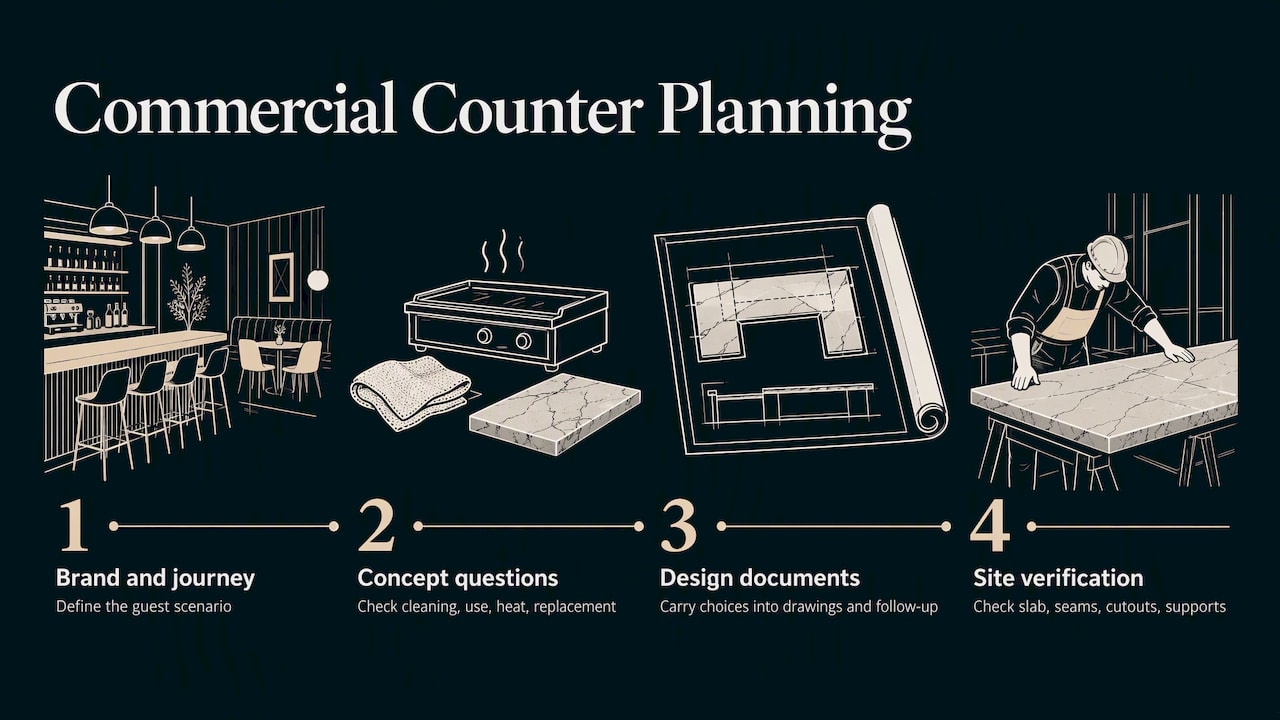
Our approach is to settle these questions in the concept phase, then carry them through visualization, drawings and supplier follow-up. Slab selection, seam layout and edge detail are drawn once and checked on site,so that what guests see matches the rendering. Our [construction drawings guide] explains how detailed documentation prevents rework, and the same discipline applies to stone: seams, cutouts and supports are decided on paper, not on installation day.
Our rule of thumb: use granite where heat and weather are real risks, use quartz where uniformity and low upkeep matter most, and never choose either without seeing the actual slab in the light of the room.
— slava
Designing a venue? We can specify it for you
If you are planning a restaurant, hotel or commercial space,we handle the full chain from [preliminary design] through furniture,[materials and accessories]and [site and supplier follow-up]. That includes choosing the right stone for each counter,drawing the details and checking the result against the plan. You can see how we apply materials in practice in our [Lila Izakaya restaurant interior],or start with our [services overview].
FAQ
Is quartz more durable than granite?
Not clearly. Both earned Excellent ratings for cutting, abrasion and heat in Consumer Reports testing, and both can chip at a hard-hit edge. Quartz resisted staining better in those tests, while granite copes better with hot cookware.
Can I put a hot pan on a quartz countertop?
It is best not to. Quartz contains resin, and a hot pan can mark or crack it. Use a trivet or heat pad every time, and follow the care instructions of your specific brand.
Does granite really need to be sealed?
Yes, periodically, to prevent stains. How often depends on the stone, so ask the fabricator for the schedule that suits your slab. Quartz is non-porous and does not require sealing.
Which is better for a restaurant or bar?
Both work for front-of-house surfaces such as bars, host stands and buffet counters. Choose granite near heat or outdoors, and quartz when you want uniform color and no sealing routine. For food-prep areas behind the scenes, stainless steel remains the usual standard.
Which one costs less?
It depends on the slab, edge, layout and your city. Entry-level granite can cost less than quartz, and rare granite can cost more than premium quartz. Get written quotes for both materials on the same layout.
Sources
- Consumer Reports:[quartz vs. granite kitchen countertops]
- HowStuffWorks:[quartz vs. granite durability]
- Worktop Fabricators Federation:[man-made and natural stone surface guide]
- Kitchen Specialists Association:[fabrication and installation guidelines]
- Panda Surfaces:[frequently asked questions]
- Martha Stewart:[how to choose granite or quartz]
- Natural Stone Institute:[embodied carbon and natural stone]
- Natural Stone Institute:[natural stone countertops]
- [Corian Quartz environmental product declaration]
- [Commercial kitchen countertop guide]