Room by Room: Carpet Tiles vs Broadloom for Facility Managers
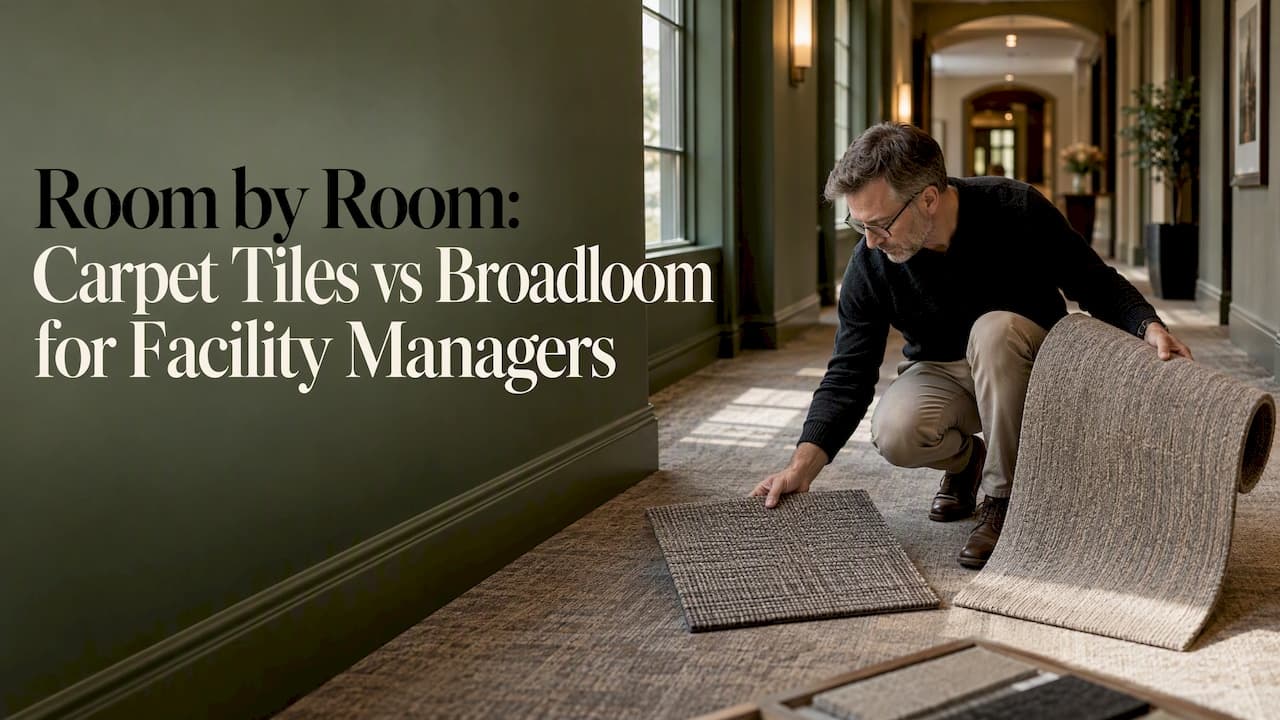
Carpet tiles suit high-traffic corridors, open offices and anywhere maintenance access matters, while broadloom fits seamless, image-driven rooms like executive suites and hotel guest rooms,a split supported by [CRI installation standards] and life-cycle cost research. Most commercial projects end up mixing both formats, and the right call often comes down to subfloor condition, traffic pattern and how fast a space needs to be back in service after a repair.
TL;DR:
- Carpet tile requires less substrate preparation and allows zone-by-zone installation, making it easier to work in occupied spaces.
- Broadloom offers a seamless, luxurious appearance with larger-scale patterns but often requires more waste and full-panel replacement for damages.
- Life-cycle cost analysis shows modular carpet generally has lower long-term costs due to easier repairs and maintenance, especially in high-traffic areas.
- The initial cost varies based on material and installation factors, but tile can be more affordable over time when maintenance and durability are considered.
- Combining both formats based on traffic, space function, and access needs often yields the best balance of cost, aesthetics, and operational flexibility.
Table of Contents
- How installation methods differ between the two formats
- Broadloom's strengths and weaknesses in commercial settings
- Carpet tile's strengths and weaknesses in commercial settings
- Comparing upfront price against total cost of ownership
- Balancing pattern, seams and brand expression in the design
- Maintenance routines that extend the life of either format
- Choosing the right format room by room
- Our approach to specifying flooring that performs
- Flooring as a long-term asset, not a one-time purchase
- How we help you get flooring specification right
- FAQ
- Sources
How installation methods differ between the two formats
Broadloom typically goes down by stretch-in, direct glue or double-stick methods, and most specifications call for a separate pad underneath for cushioning and acoustic performance. Carpet tile skips that step in most cases: integrated backing lets installers use pressure-sensitive adhesive, tape or a floating method with no pad required, according to CRI maintenance guidance.
Both formats depend on substrate prep, and CRI 104 calls for acclimating materials and conditioning the subfloor before installation begins.
- Broadloom needs a flatter, more uniformly prepared subfloor since stretch-in and glue-down methods telegraph imperfections.
- Carpet tile tolerates minor substrate variation better, which shortens prep time in older buildings with uneven slabs.
- Existing adhesive residue from a prior installation often needs full removal before either format goes down correctly.
- Tile installation generally disrupts occupied spaces less, since crews can work zone by zone without closing an entire floor.
Broadloom's strengths and weaknesses in commercial settings
Broadloom delivers a continuous, seamless surface that reads as more upscale in lobbies, executive offices and hotel rooms, and the pad underneath adds comfort and acoustic damping that modular tile struggles to match without extra layers. Large-scale patterns and custom motifs also render more cleanly across broadloom's uninterrupted width.
- Seamless installation supports a higher-end look in prestige and image-critical rooms.
- Pad underneath improves underfoot comfort and sound absorption.
- Large, continuous patterns and logos render without visible breaks.
- Installation waste runs higher since rolls must be cut to room dimensions.
- Repairs after a stain or burn often require replacing an entire panel rather than a small section.
Carpet tile's strengths and weaknesses in commercial settings
Carpet tile's biggest operational advantage is modularity: a damaged section gets replaced in minutes without closing the room or matching an entire roll. That same modularity supports creative layouts, color blocking and wayfinding patterns that broadloom cannot easily reproduce, and many tile lines use recycled-content backing as a sustainability feature.
- Damaged tiles swap out individually, cutting downtime and waste compared with a full broadloom repair.
- Modular layouts support color blocking, wayfinding cues and mixed patterns within one floor.
- Many backings include recycled content, which helps meet sustainability targets.
- Seams between tiles can show, especially under raking light or with heavy traffic.
- Without a pad, tile underfoot feels firmer, and adhesive cure times vary by backing type.
Comparing upfront price against total cost of ownership
Installed cost depends on material grade, labor rate, waste factor, pad requirements and how much substrate prep the existing floor needs. Broadloom's waste factor and pad add to the initial bid, while carpet tile often prices higher per unit but cuts labor and waste on the installation side.
Comparing quotes on install day only tells part of the story. [Life-cycle cost analysis] accounts for maintenance, repair frequency and replacement cycles over the flooring's service life,and an [academic LCCA study] found modular carpet frequently comes out ahead when those factors are included against functionally equivalent alternatives.
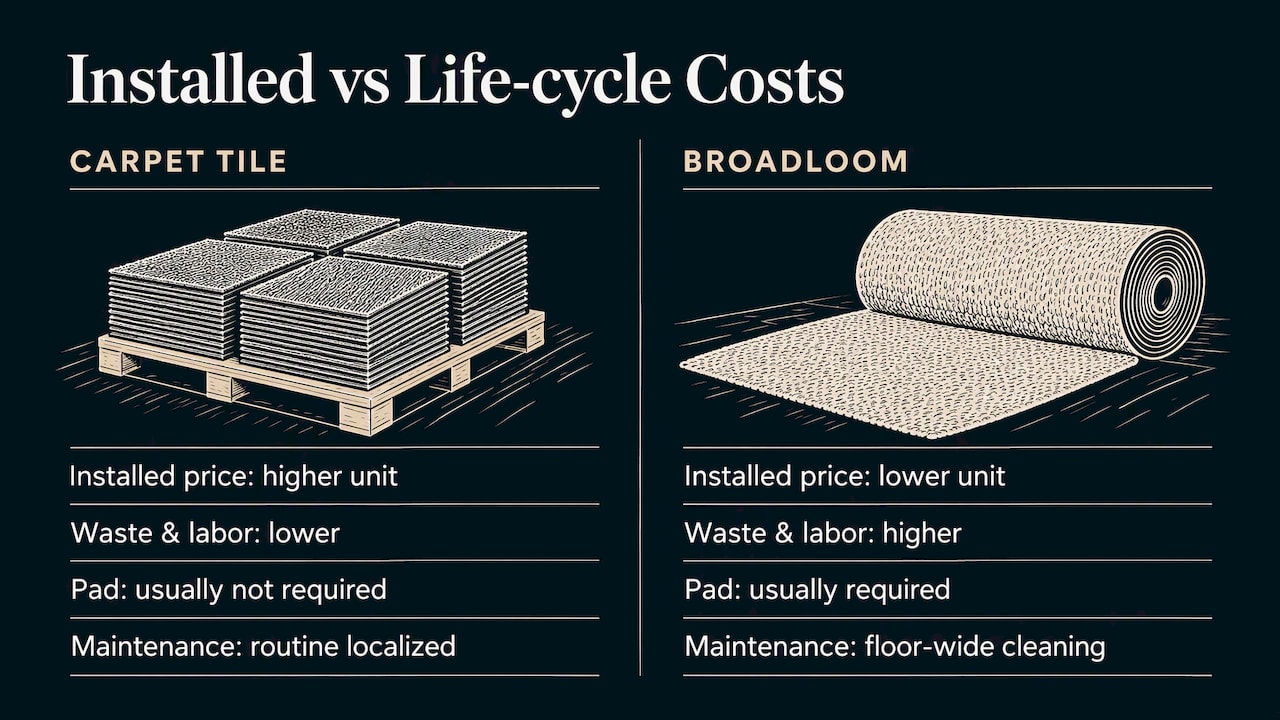
Modular carpet often shows a lower life-cycle cost than comparable flooring types in typical office scenarios, according to NWFA's life-cycle cost analysis, which recommends LCCA as the framework for procurement decisions rather than relying on installed price alone.
Balancing pattern, seams and brand expression in the design
Broadloom still wins when a space needs a large, uninterrupted pattern or a prestige finish, think executive boardrooms or a hotel's signature restaurant. Carpet tile can mimic many of those effects at smaller scale and adds options broadloom cannot: color blocking for wayfinding, accent zones that reinforce brand identity, or graphic inserts near entrances.
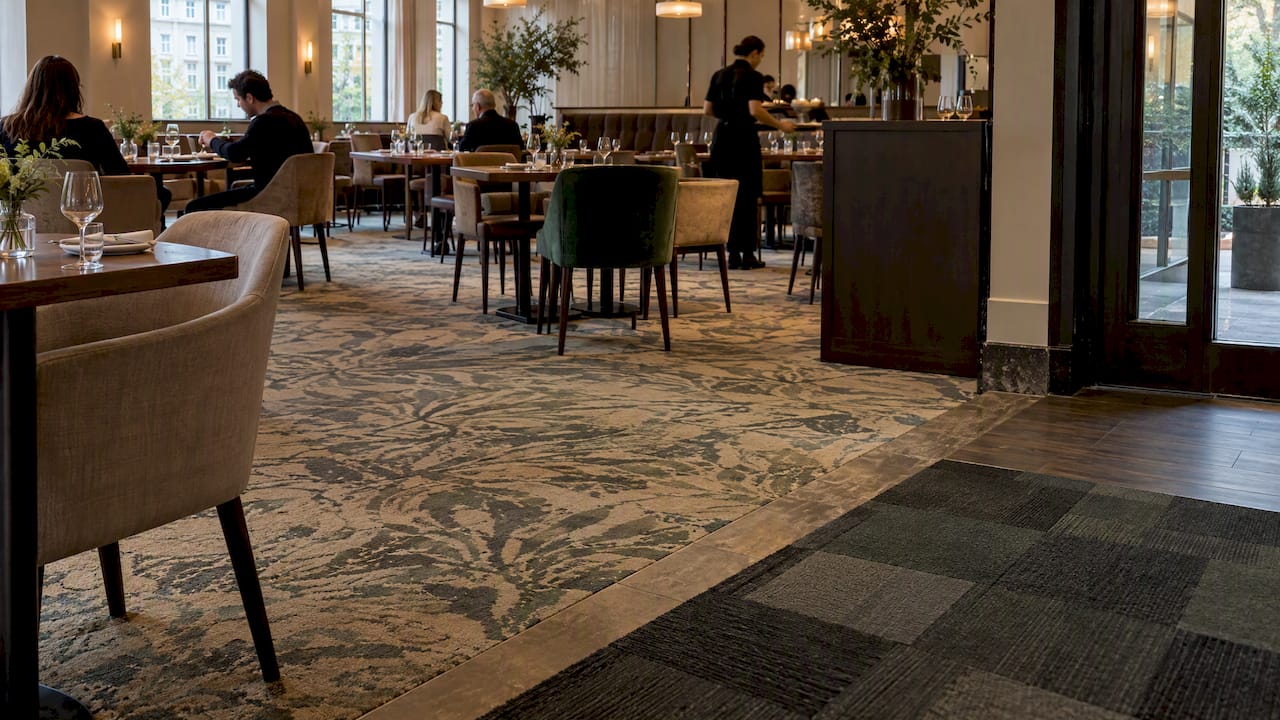
Padded tile backings and separate underlays close much of the comfort gap with broadloom. Seam visibility shrinks with tighter tolerances at installation and careful transition detailing where flooring meets hard surfaces, a detail CRI installation guidance addresses directly.
Maintenance routines that extend the life of either format
Appearance retention depends more on a planned maintenance program than on format alone, per CRI 204. Vacuum frequency, extraction cleaning and prompt spot treatment all need to scale with traffic volume and color choice.
- Vacuum high-traffic zones daily and lower-traffic rooms on a lighter schedule based on soil load.
- Schedule hot-water extraction or equivalent deep cleaning at intervals matched to traffic and manufacturer recommendations.
- Treat spots immediately, since dwell time affects whether a stain sets into the fiber.
- Swap individual carpet tiles when damage occurs rather than scheduling a full-room replacement.
- Specify moisture barriers or alternate formats in healthcare and food-service areas where spills are frequent.
Choosing the right format room by room
A quick space-by-space rule simplifies most specification decisions. Corridors, open offices and service areas favor carpet tile for access and replacement speed. Lobbies, executive suites, hotel guest rooms and banquet halls often justify broadloom's seamless finish. Meeting rooms can go either way depending on how often the room gets reconfigured.
- Corridors and open offices: carpet tile, for traffic tolerance and spot replacement.
- Lobbies and banquet halls: broadloom, for the seamless, prestige look.
- Hotel guest rooms: broadloom, for comfort and a quieter underfoot feel.
- Service and back-of-house areas: carpet tile, for fast repair and access to utilities below the floor.
Many projects mix formats deliberately: tile in corridors and access zones, broadloom in the rooms guests actually linger in.
Pro Tip: Before finalizing a spec, confirm subfloor condition, expected traffic volume, access needs, the maintenance program in place and the budget envelope, since any one of those can flip the recommendation.
Our approach to specifying flooring that performs
We balance aesthetics against maintenance and procurement reality by building flooring decisions into [preliminary design] work from the start,then confirming pattern and color choices through [3D visualization]before anything is ordered. Our [execution drawings] spell out substrate remediation, seam placement and transition details so contractors are not guessing on site, which is often where avoidable cost creeps into a flooring budget.
Flooring as a long-term asset, not a one-time purchase
Choose format by function, plan the maintenance program before installation day, and stay open to mixing tile and broadloom across one project. Facilities and design teams that coordinate early tend to avoid the costliest surprises later.
— slava
How we help you get flooring specification right
Beyond flooring, we bring preliminary design, 3D interior visualization,execution drawings and [site and supplier follow-up] together so a flooring choice holds up once contractors are on site.

- Preliminary design aligns flooring choices with brand identity and traffic patterns from day one.
- 3D visualization lets stakeholders approve colors and large-repeat patterns before ordering.
- Execution drawings resolve substrate prep and transition details before installation begins.
- Site and supplier follow-up confirms adhesive selection and installation quality against spec.
If a flooring decision is part of a larger hospitality or commercial fit-out,[request a scoped proposal] and we will walk through the specifics with you.
FAQ
What is the difference between broadloom and carpet tile?
Broadloom is manufactured and installed in continuous wide rolls, usually stretched, glued or double-stuck over a separate pad, while carpet tile comes in modular squares with integrated backing that installs without a pad in most cases. The practical difference shows up most in repairs: broadloom damage often means replacing a large section, while a damaged carpet tile gets swapped individually.
What are the disadvantages of carpet tiles?
Carpet tile seams can be visible under certain lighting or heavy traffic, and without a pad the surface feels firmer underfoot than broadloom. Adhesive cure times and backing performance also vary by product line, so following manufacturer specifications matters for long-term appearance.
Are carpet tiles better than broadloom carpet?
Neither format is universally better: carpet tile tends to suit high-traffic, access-driven spaces because of its easy replacement and lower installation waste, while broadloom suits seamless, image-critical rooms. Life-cycle cost analysis often favors modular carpet in typical office scenarios when maintenance and replacement cycles are factored in.
Is it cheaper to install carpet tile or broadloom?
Installed price depends on material grade, labor, waste factor and whether a pad and heavy substrate prep are required, so neither format is cheaper in every case. Looking at life-cycle cost rather than installed price alone gives a clearer answer, and LCCA research found modular carpet frequently scores well against comparable flooring over its full service life.
Sources
- [CRI 104 — Standard For Installation of Commercial Carpet]
- Life Cycle Cost Analysis (NWFA)[— 2023]
- Life-cycle cost analysis (LCCA):[a comparison of commercial flooring — Emerald Insight]