Solid Surface vs Quartz: Which Wins in Commercial Spaces
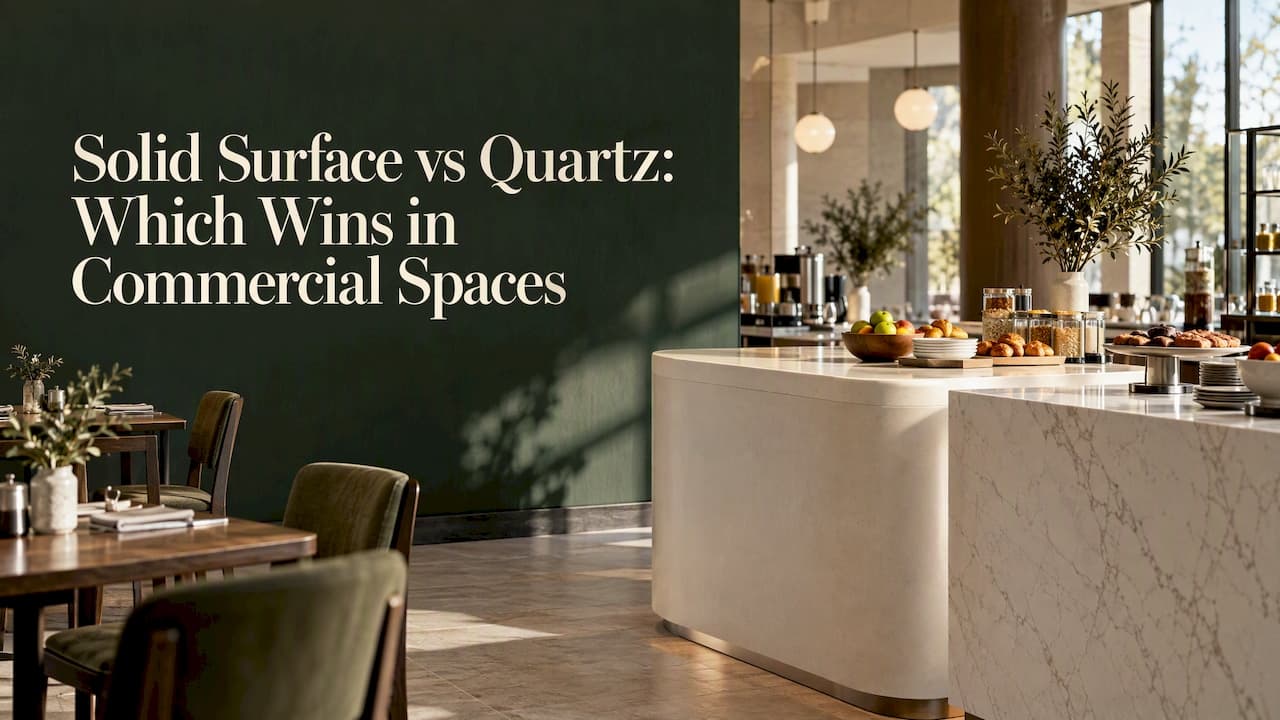
Choose quartz where a surface faces knives, trolleys and constant abrasion and you want a stone-like look. Choose solid surface (Corian is the best-known name) where you need seamless runs, curves, integral sinks or repairs that can be done on site. Neither material likes hot pans. The right answer depends on the zone, not on a single winner.
This guide compares the two the way a hospitality designer does: by how they behave in a hotel bathroom, a bar top, a reception desk or a restaurant pass, and what you should specify before anything is ordered.
TL;DR
- Quartz is harder and more scratch-resistant, and it tolerates heat somewhat better. Its joints stay visible, and chips are difficult to hide.
- Solid surface is softer and can show knife marks, but it can be sanded and repaired in place, joined without visible seams and thermoformed into curves.
- Both are non-porous, need no sealing, and should be protected from hot cookware with trivets or pads.
- Engineered quartz carries silica dust rules during cutting and fabrication. In the US, dry cutting on site is prohibited.
- For hospitality, mix them: quartz for hard-working prep and bar zones, solid surface for vanities, reception and sculpted elements.
Table of Contents
- Solid surface vs quartz at a glance
- What each material actually is
- Scratches, stains, impact and heat
- Maintenance and repair
- Seams, curves and design freedom
- Silica dust: a fabrication and installation issue
- Which one for which zone
- What to check before you specify
- Perspective
- Choosing surfaces with a hospitality design team
- FAQ
- Sources
Solid surface vs quartz at a glance
| Criterion | Solid surface | Quartz |
|---|---|---|
| Make-up | Acrylic or polyester resins with mineral fillers, a homogeneous mass | Mostly ground natural quartz bound with resin and pigments |
| Look | Uniform color and texture, no visible mineral particles | Visible particles, a more stone-like pattern |
| Seams | Can be joined without visible seams | Joints remain visible, especially on large runs |
| Scratch resistance | Softer, shows knife marks and abrasion | Significantly harder |
| Heat | Scorches and can melt at lower temperatures | Scorches above roughly 300°F |
| Impact | Absorbs impact better | Can chip or crack from a sharp blow |
| Repair | Can be sanded and refinished in the field | Chips can be filled, but repairs are usually visible |
| Shaping | Thermoformed curves, integral sinks | Flat cuts only |
| Sealing | Not required | Not required |
The sections below explain each row and what it means for a space that is used all day.
What each material actually is
Solid surface combines alumina trihydrate with acrylic resins into a single mass,[according to a manufacturer's technical comparison]. The color runs all the way through the sheet, which is why it can be cut, joined and sanded without exposing a different core.
Quartz is a composite that is mostly natural quartz particles held together with polyester resins and pigments. A [comparison of the two materials] puts ground quartz at 90 to 94 percent of the slab, with solid surface being an acrylic or polyester blend with mineral fillers. That high mineral content explains both its hardness and its silica dust issue, which we cover below.
How they look in a finished room
Solid surface reads as calm and uniform. It suits soft, monolithic interiors: a spa-like hotel bathroom, a sculpted reception desk, a bar front that curves into the top. Quartz reads as stone. It shows mineral flecks and veining patterns, which makes it a natural choice when the concept calls for the look of marble or concrete without the maintenance of natural stone. If you are also weighing natural stone,our comparison of [quartz vs granite countertops] covers that decision.
Scratches, stains, impact and heat
Scratches and stains
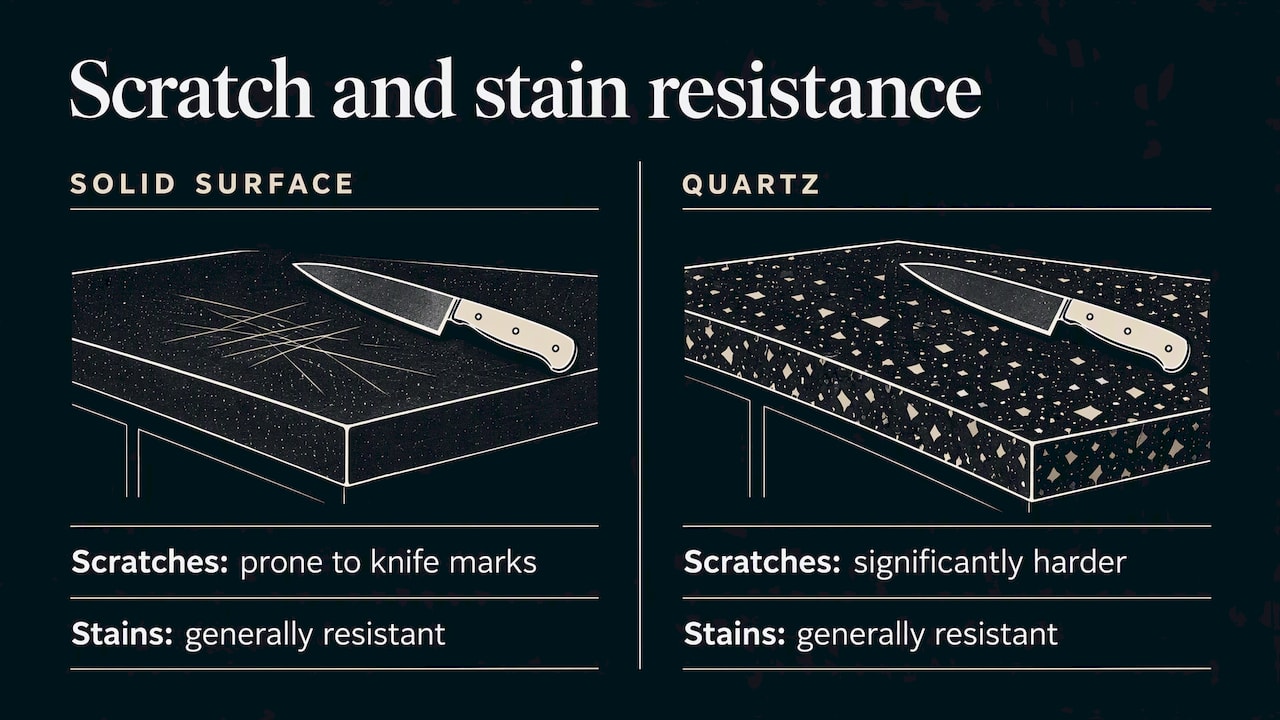
Quartz is significantly harder than solid surface, which is prone to knife marks and abrasion,[per the same comparison]. In a restaurant, that matters on any surface where staff cut, drag trays or slide crates. Both materials are non-porous and generally stain-resistant, so wine, coffee and sauces wipe off rather than soak in.
Consumer Reports' lab testing also found that [material choice matters far more than brand]: performance differs significantly between categories such as solid surface and quartz, while brands within one category perform similarly. So spend your decision time on the material and the fabricator, not on chasing a label.
Heat
Neither material is a heat shield. Quartz scorches above approximately 300°F, while solid surface scorches and melts at lower temperatures,according to [the comparison]. Quartz manufacturers say the same in practice:one [architectural reference guide] advises hot pads or trivets under hot skillets, pans and other heat-generating appliances.
For a commercial kitchen or a hotel breakfast buffet, the practical rule is simple: build in heat-safe landing zones (stainless steel, ceramic or a trivet rail) wherever hot cookware or warming equipment will sit, whichever material you choose.
Impact
Solid surface absorbs impacts better, while quartz can crack or chip from a sharp blow. A dropped cast-iron pan on an edge is the classic case. Rounded edges reduce risk for both materials, and are a sensible detail on bar fronts and reception counters where carts and luggage collide with corners.
Maintenance and repair
Both are non-porous and neither needs regular sealing, which separates them from natural stone. Day-to-day cleaning is soap and water or a non-abrasive cleaner for both.
The difference shows up after damage. Solid surface is repairable and refinishable in the field,while engineered quartz is harder and more scratch- and stain-resistant but [is not field-refinishable]. A scuffed solid surface counter can be sanded back to a uniform finish. A chipped quartz edge can be filled, but the repair is usually visible, and scorch marks or deep scratches are permanent.
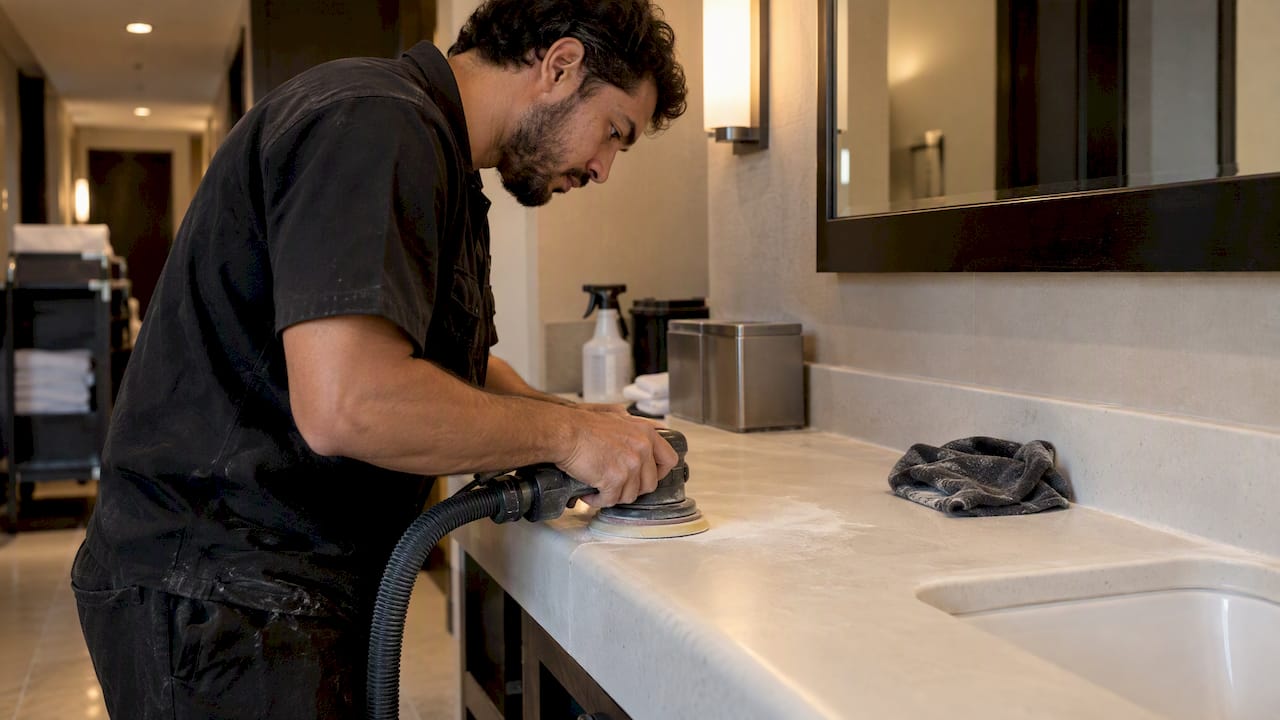
For an operator,that translates into downtime. A manufacturer notes that [solid surface repairs can be made locally], minimizing downtime and operating costs, whereas damaged quartz usually means replacing the piece. In a hotel with a fixed number of rooms,a vanity that can be refreshed overnight is worth real money. We make the same argument about durable details in our piece on [hotel bathroom design that lasts].
Seams, curves and design freedom
This is where solid surface pulls ahead for commercial work. It allows joints without visible seams, thermoformed curves and integral sinks, while quartz has visible joints and cannot be thermoformed, so its cuts are flat,[as the manufacturer's comparison explains].
What that unlocks:
- Long runs. A 20-foot bar or reception desk can read as one piece rather than a sequence of slabs with joints.
- Curved and sculpted forms. Rounded fronts, wraparound counters and soft corners are possible through thermoforming.
- Integral sinks and backsplashes. A sink molded into the top removes the rim and crevice where grime collects, which suits hotel bathrooms and washrooms.
- Hygiene-led spaces. Corian's product literature lists commercial uses including lodging, healthcare, banks, boutiques,[restaurants and laboratories], and notes that its sheets can be thermoformed into 2D and 3D designs.
Quartz answers with a different strength: consistency and a stone-like surface that holds its edge. If the concept is a crisp, architectural counter with a mitered waterfall end, quartz does that well. Just plan joint locations on the drawings, because they will be seen.
Silica dust: a fabrication and installation issue
Engineered quartz is the material with a safety dimension that buyers should know about before they sign off a scope. A UK supplier's comparison notes that [engineered quartz contains roughly 90 percent crystalline silica], that Australia banned engineered stone in 2024, and that the UK has no ban but prohibits dry cutting of stone worktops. Rules differ by country, so check what applies to your site.
In the United States,dry-cutting engineered quartz on site is prohibited. Field cutting must be wet and use local exhaust ventilation under [29 CFR 1926.1153]. In practice, that means:
- Have slabs cut, drilled and edged in a controlled shop wherever possible.
- Write wet cutting and dust control into the installer's method statement.
- Keep the site clean,using methods designed for fine dust rather than dry sweeping. A guide to [silica dust cleanup methods] explains the safer approaches and equipment.
- Ask your fabricator how they handle dust control and worker protection, and get the answer in writing.
Solid surface is not dust-free to work with, and the same basic site discipline applies, but the crystalline silica load is the concern that is specific to quartz.
Which one for which zone
A hotel or restaurant is not one environment. Matching material to zone avoids the false choice.
| Zone | Better fit | Why |
|---|---|---|
| Hotel bathroom vanity | Solid surface | Integral sink, no joints to trap grime, quick on-site refresh |
| Reception desk, concierge | Solid surface | Curves, long seamless runs, sculptural freedom |
| Restaurant prep or service counter | Quartz | Hard-wearing against knives and trays, with heat landing zones added |
| Bar top | Either | Quartz for scratch resistance, solid surface for a continuous, curved front |
| Spa, clinic, wellness areas | Solid surface | Non-porous, repairable, easy to detail without joints |
| Large lobby feature surface | Depends on concept | Quartz for stone look, solid surface for monolithic form |
The heavier material also affects structure. Quartz is heavy, which can influence structural support requirements during installation, so involve the engineer and cabinetmaker early on any cantilevered or wall-hung element.
Flooring and counters are judged together by guests,so it helps to decide them in one pass. Our guide to [restaurant flooring options by zone] follows the same logic of matching a material to what actually happens in each area.
What to check before you specify
The cheapest mistakes are made on paper. Before a material goes into the drawings, confirm:
- The fabrication partner. Experience with your material, shop capacity, dust control and references from commercial jobs.
- Slab size. It determines where joints fall, which matters most for quartz.
- Edge profile. Eased or rounded edges resist chipping and suit high-traffic counters.
- Thickness. It affects weight, support and the visual proportion of the edge.
- Certifications. Ask for the product's documented compliance for its intended use, such as food-contact or healthcare settings.
- Heat and cleaning guidance. Get the manufacturer's written care instructions, then pass them on to the operator.
Cost deserves its own check. Published per-square-foot ranges vary widely by region, pattern, edge and fabricator,so ask for itemized quotes on your actual drawings rather than relying on averages. Our overview of [what to budget for restaurant interior design] shows where surfaces sit within the wider budget.
Perspective
In our experience designing restaurants, hotels and large commercial spaces, the material debate is rarely about which surface is "better". It is about what the room has to do at 7 a.m., at the Friday rush and at 2 a.m. during cleaning.
We start from the brand and the guest journey, then assign materials by zone. The long, curved welcome desk and the guest bathroom vanity ask for seamless, repairable surfaces. The prep line and service bar ask for hardness and a clear plan for hot items. When we put both materials in one project, each does the job it is best at, and the space feels coherent rather than compromised.
What protects a project is the paperwork around the material: joint positions on the execution drawings, edge details, support requirements, and a fabricator who is followed up on site. That is where hospitality interiors succeed or lose weeks to rework, and it is why we stay with a project from concept through supplier follow-up.
slava
Choosing surfaces with a hospitality design team
If you are choosing between solid surface and quartz for a hotel, restaurant or commercial development, we can help you settle it inside the concept rather than at the end. Our team handles furniture,[materials and accessories selection],and then carries the decision through [execution drawings] so joints, edges and supports are resolved before ordering.
We also follow the work through fabrication and installation with [site and supplier follow-up]. To discuss your project,start at [BOOM Project].
FAQ
Is solid surface or quartz better for a commercial kitchen or bar?
Quartz usually suits hard-working prep and bar tops better because it is harder and resists scratches and abrasion. Solid surface can work where a continuous curved form matters more, but it shows knife marks and scorches at lower temperatures. In either case, provide heat-safe zones for hot pans.
Is Corian the same as solid surface?
Corian is a well-known brand of solid surface, an acrylic-based material with mineral fillers. Its product literature lists commercial uses such as lodging, restaurants and laboratories, and says the sheets can be thermoformed. Other solid surface products behave similarly, though you should check each product's data sheet.
What are the downsides of solid surface and of quartz?
Solid surface is softer, can show scratches and knife marks, and scorches or melts at lower temperatures, although it can be sanded back. Quartz is harder to repair, visible joints are hard to avoid, and scorch marks and deep scratches are permanent. Quartz also brings silica dust controls during cutting and fabrication.
Do either of them need sealing?
No. Both are non-porous and neither needs regular sealing, unlike natural stone. Clean with soap and water or a non-abrasive cleaner, and avoid leaving hot cookware directly on either surface.
Is quartz safe to have in a finished space?
The main concern is silica dust created while cutting and fabricating, not the finished, installed surface. In the US, dry cutting engineered quartz on site is prohibited and wet cutting with local exhaust ventilation is required. Ask your fabricator for their dust control plan and have it written into the contract.
Sources
- Solid Surface vs Quartz, manufacturer comparison (US)[]
- Solid Surface vs Quartz, manufacturer comparison (repairs and downtime)[]
- [Quartz vs Solid Surface Countertops 2026] - Best Countertop Buying Guide,[Consumer Reports]
- Architectural reference guide,[quartz care and heat]
- Solid Surface and Quartz Countertops,[construction reference]
- [Corian solid surface product information] - Solid Surface vs Quartz, Granite,[Laminate and Porcelain]
- [Silica dust cleanup methods]