Smart Hotel Room: What It Is and How to Design One
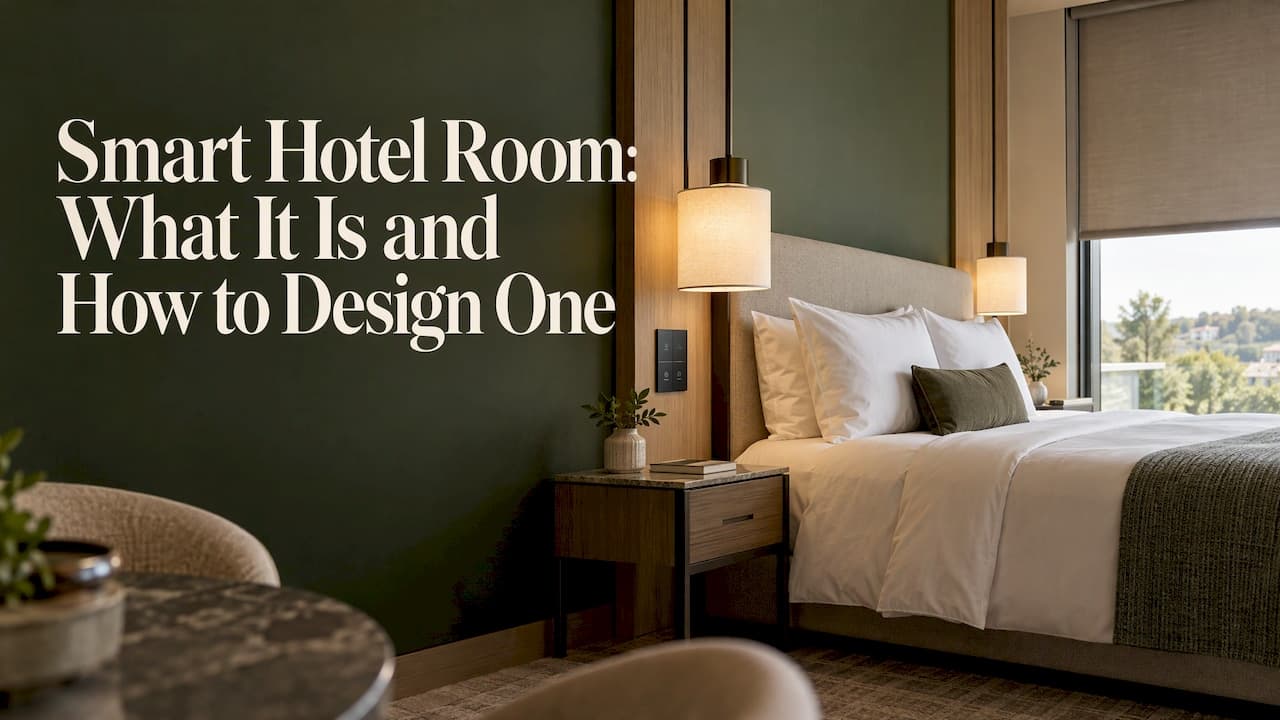
A smart hotel room is a room where connected devices and systems, such as locks, thermostats, lighting, shades and controls,work together and can be managed by the guest and by staff. [ABI Research] describes these rooms as ones that deploy intelligent devices and systems, often IoT-enabled, to provide greater connectivity. The technology is the easy part to buy. The hard part is designing a room where it disappears into the experience, and that is a design question as much as a technical one.
This guide is for hotel owners, developers and property managers planning a new build or a renovation. It covers what the technology is, what it does for guests and operators, how to fit it into the room without losing character, and what to settle before you sign a single purchase order.
TL;DR
- A smart room links lighting, climate, shades, access and service requests into one coordinated system, usually tied to the property management system (PMS).
- Guests value control and comfort. Operators gain energy efficiency, maintenance alerts and better staff allocation.
- Simple wins: research found smart lighting rated highest by guests, while complex interfaces raised mental effort.
- Bring the interior designer, engineers and IT team together at concept stage, not after the layout is fixed.
- Phase the rollout, plan for outages and privacy, and keep physical controls as the baseline.
Table of Contents
- What makes a hotel room "smart"
- The technology inside the room
- Why smart rooms matter to guests and owners
- Designing the room around the technology
- What to settle before you buy
- Helping guests actually use it
- Perspective: the room should feel designed, not wired
- How we can help
- FAQ
- Sources
What makes a hotel room "smart"
A conventionally equipped room has devices that work independently: a switch for each light, a thermostat on the wall,a key card at the door. A smart room connects them. [Hotel Facility Guide] names four baseline traits: networked sensing, integrated control of several room systems, personalization of settings, and remote management by staff or software.
In practice that means the room knows whether it is occupied, can set a comfortable temperature before arrival, can dim the lights for the evening and can tell housekeeping or engineering what it needs. A guest might never notice any of this. That is the point.
The technology inside the room
Most smart rooms are built from a handful of building blocks. Here is what each one does and what it means for design.
| System | What it does | Design implication |
|---|---|---|
| Smart lock | Supports mobile or contactless entry through Bluetooth, NFC or Wi-Fi,according to [ABI Research] | Door hardware finish, reader placement, power and battery access |
| Climate control | Adjusts HVAC using occupancy and environmental data | Thermostat or sensor location, ceiling and wall clearance |
| Lighting control | Recalls preset scenes and dims by zone | Fixture selection, driver compatibility, switch plate design |
| Motorized shading | Opens and closes curtains or blinds on schedule or command | Curtain pockets, track depth, power routing |
| Entertainment | Streaming, casting, in-room screens | Screen position, cable concealment, millwork |
| Service requests | Do Not Disturb, Make Up Room and similar signals | Panel placement at bedside and entry |
A [hotel room management system] typically integrates lighting, air conditioning, curtains, door access, entertainment and these service requests, and connects to the PMS for check-in, check-out and occupancy status.
Sensors you never see
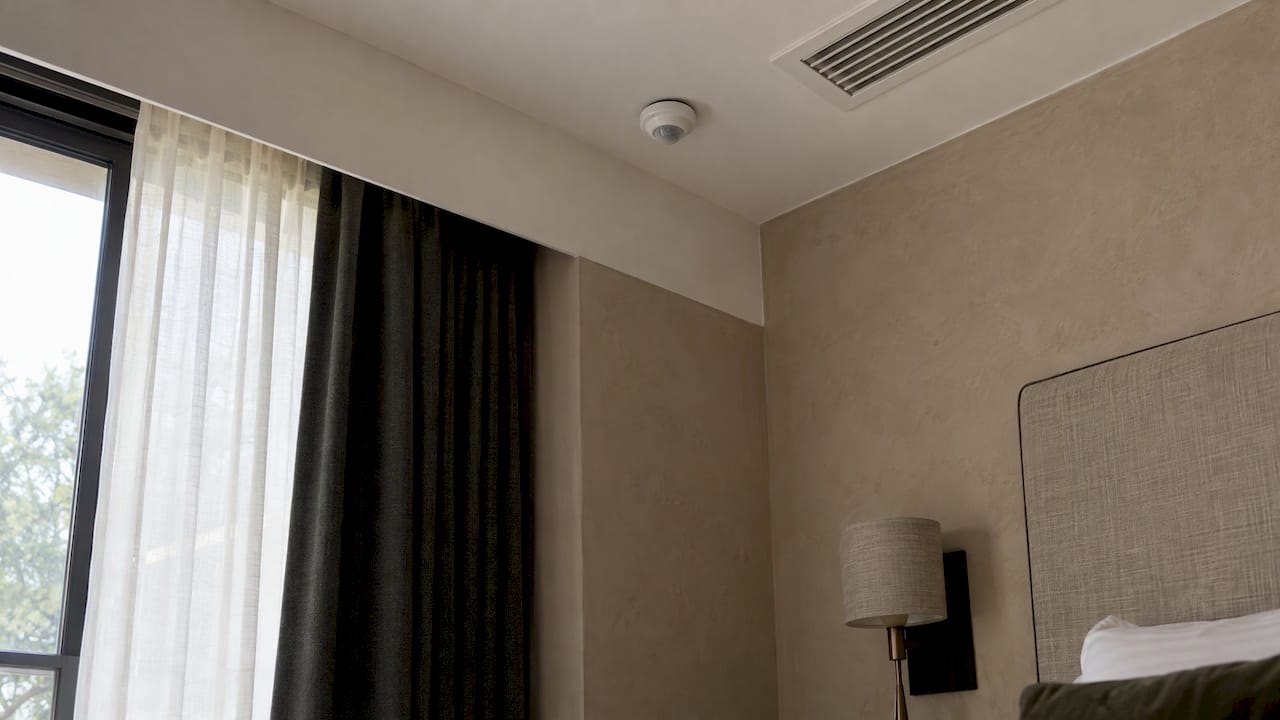
Some of the most valuable technology is invisible. ABI Research notes that occupancy tracking can [optimize HVAC and lighting], while environmental sensors can account for humidity, air quality,outside temperature and solar gain. [Design for Travel] says the same data can adjust HVAC, lighting and shading automatically while preserving comfort.
For a designer, invisible does not mean unplanned. Every sensor needs a location with a clear line of sight, power and a finish that suits the ceiling or wall around it.
Guest interfaces
Guests can control a smart room through bedside or entry panels, in-room tablets,phone apps and voice assistants. Hotel Facility Guide recommends [physical controls as the durable baseline], with apps and voice as supplements, because adoption and reliability vary. We agree with that order. A guest arriving at midnight after a long flight wants a switch they can find, not a download.
Why smart rooms matter to guests and owners
For guests
According to ABI Research, guests can gain more control, contactless stays,[personalized climate and easier interaction] with hotel services. A 2021 peer-reviewed study in Information Systems Frontiers found that functional value was tied to usefulness,[control and value for money], while emotional value included sustainability, entertainment, aesthetics and playfulness. The same study found that perceived surveillance inhibited emotional value. Guests like control and dislike feeling watched.
For owners and operators
Operators can use connected systems for HVAC and lighting efficiency, energy savings, staffing allocation and maintenance alerts,[per ABI Research]. Hotel Facility Guide likewise says smart room technology can support energy management,[building maintenance and staffing]. A room that reports a failing unit before the guest complains saves a bad review and a room-out-of-order night.
Designing the room around the technology
This is where most projects succeed or fail. A smart room that looks like a control room is a worse hotel room, however clever its wiring.
Start with the guest, not the gadget
A 2025 study in Hospitality Insights observed 30 participants in a smart-equipped boutique hotel room. The design approach combined user-centricity, aesthetic integration, functional coherence,[ethical considerations and contextual awareness]. Two findings are worth carrying into any brief:
- Smart lighting scored highest, at 4.7 out of 5 for both usability and ambience.
- Smart-mirror interfaces produced higher cognitive-load scores, at 3.8 out of 5.
The study also found that cognitive load shapes guest attitudes and recommends intuitive,[simple designs rather than technology added for novelty]. Lighting is a good place to invest because guests feel it immediately. Our guide to [hotel lighting design] covers layers and specification in more detail.
Coordinate disciplines early
Design for Travel advises bringing MEP engineers, interior designers and IT together early, sharing infrastructure and control systems,and [integrating technology so it stays unobtrusive]. It adds that smart-room specifications commonly coordinate HVAC automation, lighting scenes, motorized shading and entertainment through shared low-voltage infrastructure, structured cabling, control processors and hotel-platform integration.
Translated into design work, that means decisions made before drawings are issued:
- Where does the control panel sit relative to the bed and the headboard?
- Which millwork needs ventilation or access panels for equipment?
- How does cabling reach the shades, screen and sensors without visible conduit?
- Which finishes will the panels, readers and switches share?
A room layout fixed first and technology squeezed in afterward almost always shows. Our [hotel room design guide] walks through layout and detail choices that hold up under this kind of planning.
Build scenes, not menus
The same Design for Travel guidance suggests consistent, simple controls with optional tactile controls, and scenes such as arrival, work, relax and night. Four scenes are easier to remember than twelve sliders. A guest should be able to press one button and get a room that suits the moment, and every scene should be designed with the lighting, shading and climate in mind together.
Keep the brand in the room
Technology can flatten a hotel's identity: the same black tablet, the same white panel, in every property. Choose finishes,textures and switch plates that belong to the room's material palette. We cover how design carries identity in [hospitality brand identity],and how guest moments shape space in [guest experience design for hotels]. Designers working with hospitality operators on this balance often lean on guest-centered thinking,and [guest experience marketing and operations support] can complement the design side by evaluating customer feedback and performance.
What to settle before you buy
Integration and ownership
Switch Solutions advises planning PMS,BMS and guest-app integrations [before purchasing devices], noting that older systems may need middleware and that API integration must not compromise privacy or network security. Sinoway Insights recommends defining which system owns which commands and events, including verified check-in, checkout, vacant-energy states,[maintenance alerts and failure behavior].
The same guide says essential controls should keep working locally during outages. Test failure and recovery, and plan updates, spares, backups and support.
Network and security
Hotel Facility Guide estimates that a fully equipped smart room may have [six to eight property IoT devices] before counting guest devices, and recommends a separate VLAN for property IoT and guest devices. Across a 150-key hotel,that is a sizable network. A Dynalite security statement points out that hospitality integrations may use protocols such as BACnet or FIAS that [often lack secure alternatives], so mitigating controls should be put in place.
Data and privacy
Smart-room systems may process guest-device information, preferences, room-use data and interactions. Hotel Management Network says operators should identify what is collected, where it is stored,[how long it is kept and who among third parties can access it]. Given the surveillance finding above, collect only what a feature needs and say so plainly to guests.
Accessibility
Accessible smart-room design should offer equivalent access through more than one input and output mode: tactile controls, voice, accessible mobile interfaces and staff-supported alternatives,according to an [accessibility guide for smart hotel rooms]. It also suggests writing accessibility into RFPs, technical specifications, acceptance criteria and service-level agreements, and asking vendors for evidence on conformance, testing, updates, battery failure and emergency override. For legal requirements in a US property, confirm the specifics with your accessibility consultant or counsel.
Phasing and total cost
Hotel Facility Guide recommends [phasing the rollout]: occupancy-aware thermostats and energy management first, then lighting and basic controls, then broader entertainment and app integration. Deploying every phase at once raises retrofit complexity and integration risk. Switch Solutions suggests auditing existing infrastructure, network capacity and cybersecurity readiness,and counting [total cost of ownership]: hardware, software, installation, maintenance and expected returns.
Phasing has a design consequence. Even if you install only the climate layer now, the drawings should reserve conduit, power and panel locations for the layers that follow, so the second phase does not mean opening finished walls.
Helping guests actually use it
The Hospitality Insights study lists unfamiliar interfaces, lower technological self-efficacy, initial stress, cognitive load and privacy concerns as adoption barriers, plus inconsistent device performance on the reliability side. Its remedies are brief guidance, intuitive design and simple,[consistent interfaces].
In design terms:
- Label controls with clear icons and plain words.
- Put the same panel in the same place in every room type.
- Provide a one-line welcome note that explains the main scene button.
- Make sure every function has a physical fallback.
Perspective: the room should feel designed, not wired
We see smart rooms as an interior design problem first. Technology decides what a room can do. Design decides whether a guest enjoys doing it.
Our studio works only on hospitality and commercial interiors, and the pattern repeats: the best rooms are those where the concept, the layout, the furniture and the fixtures were decided together. When a panel position is chosen after the headboard is built, the guest sees the compromise. When it is chosen in the concept stage, it looks inevitable.
That is why we work end to end, from concept and visualization through execution drawings, furniture and materials, and follow-up with suppliers on site. A smart room has more dependencies than a conventional one, and each handoff is a chance to lose the idea. Keeping the thread in one team protects both the look and the function.
Our advice to owners: decide the guest moments first, such as arrival, work, rest and sleep. Then let the technology serve those moments quietly, in a language that matches your brand.
slava
How we can help
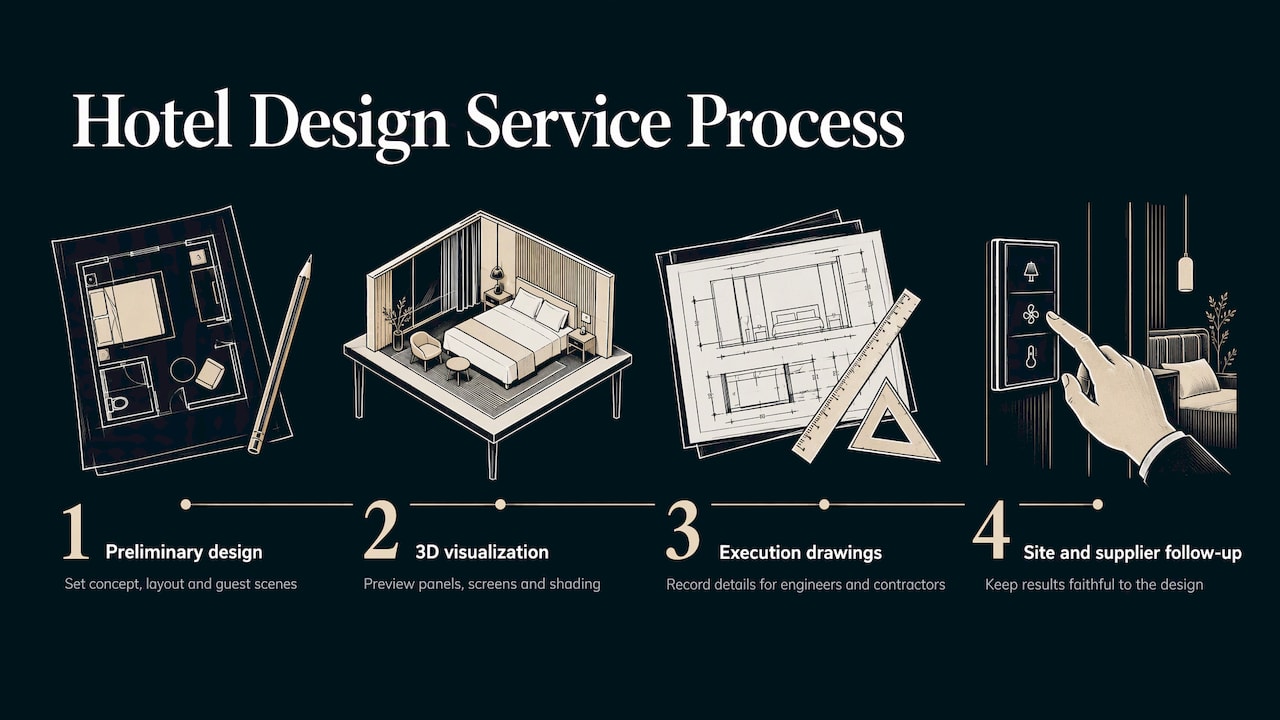
If you are planning a new hotel or renovating rooms,we design the space that the technology lives in. We begin with [preliminary design] to set the concept,layout and guest scenes. We then use [3D interior visualization] so you can see where panels, screens and shading sit before anything is built.
From there,[execution drawings] record the details your engineers and contractors need,and [site and supplier follow-up]keeps the result faithful to the design. You can see the full scope on our [services page],or [get in touch through our website] to discuss your project.
For more on where hotel interiors are heading,read our [hotel design trends] piece.
FAQ
What is the difference between a smart hotel room and a regular one?
In a regular room each device works on its own. In a smart room, systems such as lighting, climate, shades and access are connected and managed together, often linked to the PMS. Staff can monitor and manage them remotely, and guests get personalized settings.
Do guests need an app to use a smart room?
Not necessarily. Industry guidance recommends physical bedside or entry controls as the durable baseline, with apps and voice as extras, because adoption and reliability vary. Design every function so it can be reached without a phone.
Which smart feature should a hotel install first?
Hotel Facility Guide suggests starting with occupancy-aware thermostats and energy management, then lighting and basic controls, then entertainment and app integration. Lighting is also the feature guests rated highest in the 2025 Hospitality Insights study.
How do you keep a smart room from feeling cold or technical?
Plan the technology with the interior concept from the start. Use simple scenes, tactile controls and finishes that match the room's palette, and hide sensors and cabling in the architecture. Resist adding features only for novelty.
What are the main risks of a smart hotel room?
The main ones are integration gaps, network security, guest data handling and controls that fail when connectivity drops. Plan local fallback operation, separate guest and property networks, and define what data is collected and for how long.
Sources
- ABI Research:[The Technologies Underpinning Smart Hotel Rooms]
- Hotel Facility Guide:[Smart Room Technology for Hotels]
- Boutique Hotel News:[The boutique hotel owner's guide to smarter rooms]
- Design for Travel:[Smart hotel room technology]
- Hospitality Insights: Beyond convenience,[design and ease of use]
- Information Systems Frontiers study via PMC:[Smart home technology in peer-to-peer accommodation]
- Sinoway Insights:[Hotel guest-room control integration guide]
- [Dynalite security statement] - Hotel Management Network:[Smart hotel technology and cybersecurity risks]
- Switch Solutions:[Checklist for IoT Implementation in Hotels]
- [Accessible Design for Smart Homes and Hotel Rooms]