MDF vs Plywood: Which Panel Fits Your Project?
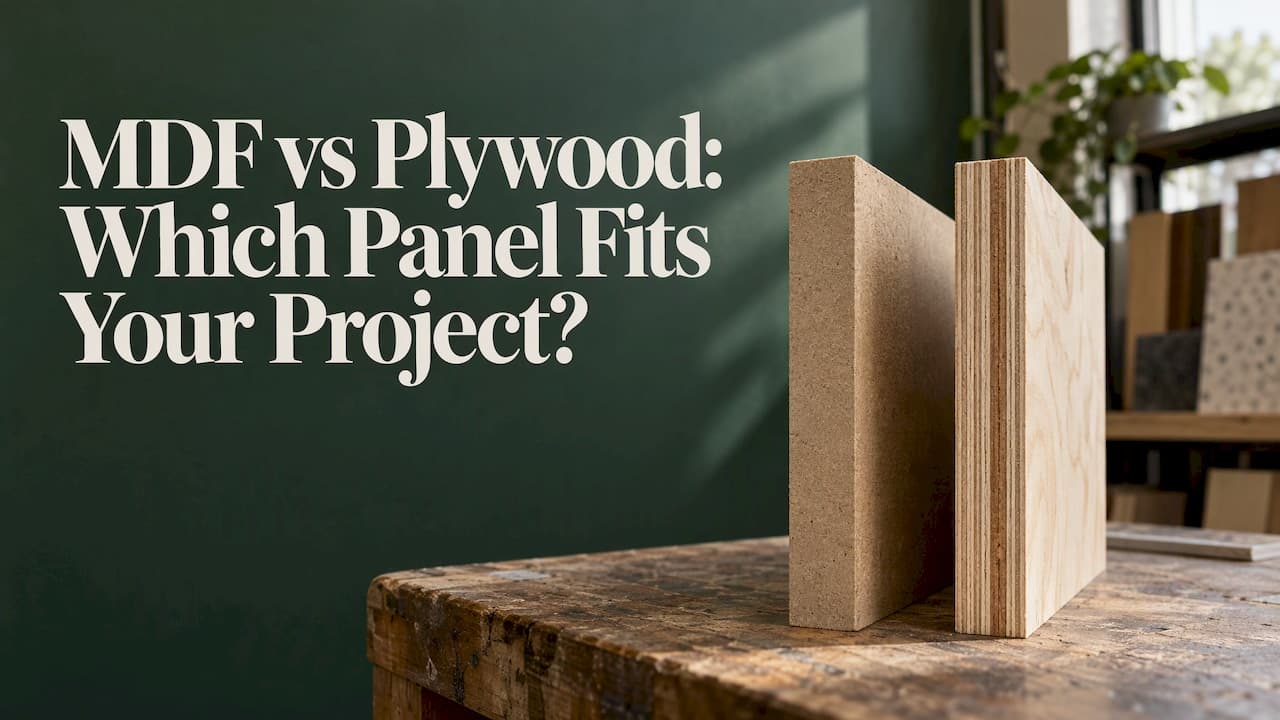
Plywood is the stronger, lighter and more moisture-tolerant panel. MDF is the smoother, more affordable one, and it is the better base for paint, laminate and routed profiles. Most interiors use both: plywood where a part carries load or takes fasteners, MDF where a flat painted or wrapped surface matters most. The sections below show how the two compare on strength, screws, weight, finish, cost and moisture, and how to write a specification that holds up on site.
TL;DR
- Strength: plywood has higher stiffness and spans further. MDF sags sooner on long shelves and should be reinforced.
- Screws: plywood holds face and edge screws better. MDF holds face screws reasonably well with pilot holes, but edge screws strip more easily.
- Finish: MDF is grain-free and ideal for paint, laminate and thin overlays. Plywood suits stain or clear finishes when the face veneer is chosen for it.
- Cost and moisture: MDF is generally cheaper but vulnerable to water. Plywood costs more and tolerates moisture better.
- Specification: "plywood" or "MDF" alone is not a spec. Define the grade, thickness, span, fixing method and service conditions.
Table of Contents
- How the two panels are made
- Strength: which is stronger, MDF or plywood?
- Screw holding and edges
- Weight, surface and finish
- Cost and moisture
- MDF vs plywood at a glance
- Where each panel belongs in a restaurant or hotel
- HDF: how it differs from MDF
- How to specify thickness and grade
- Our perspective
- Getting panels right from concept to handover
- FAQ
- Sources
How the two panels are made
The difference in behavior starts with construction. Plywood is built from veneers glued in layers, with the grain of neighboring layers running at right angles. MDF (medium-density fiberboard) is made from wood fibers pressed with resin into a dense, uniform sheet with no grain at all.
The USDA Forest Products Laboratory explains that [plywood's alternating grain directions give it significant bending strength in both directions and reduce splitting]. MDF has no such directional structure. That makes it flat and predictable to machine, but it also means it has less structural capacity than a veneer-core panel.
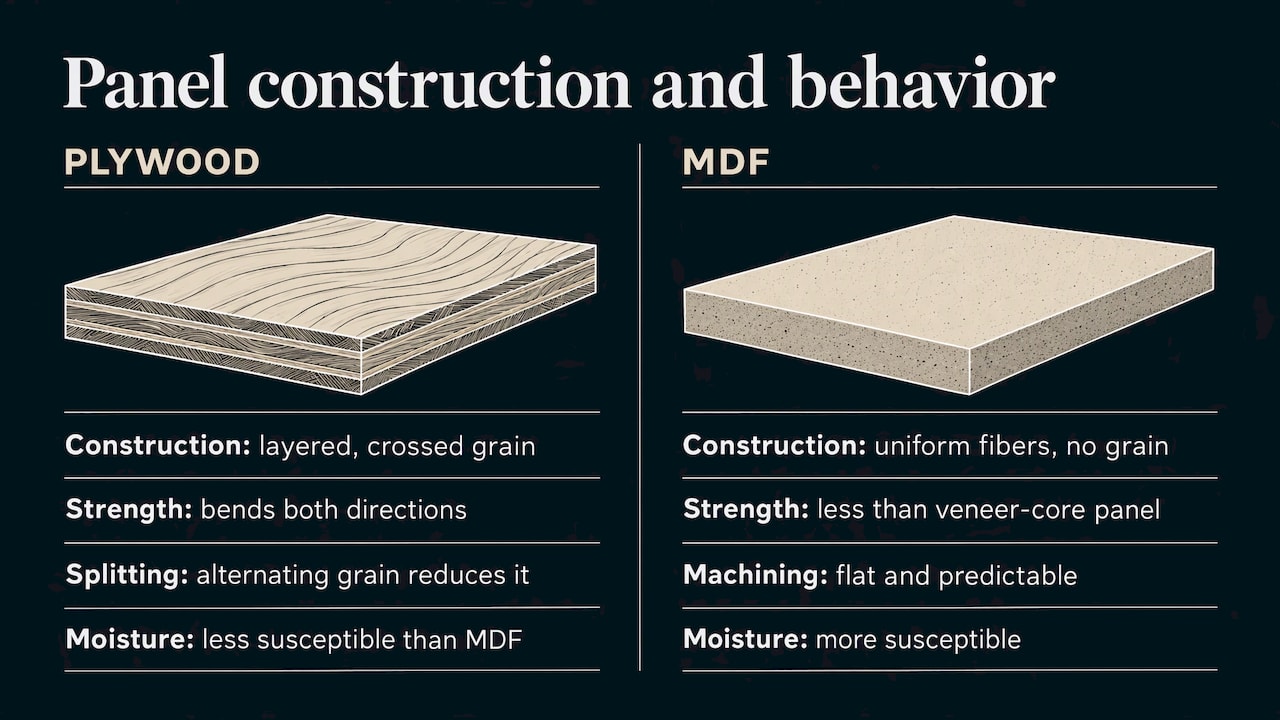
Fine Woodworking describes MDF as flat, smooth and stable in thickness, with no grain,[which suits paint or veneer]. The same article treats it as less structural, more moisture-susceptible and heavier than veneer-core panels.
Strength: which is stronger, MDF or plywood?
Plywood. For equal nominal thickness, plywood generally has higher stiffness and better spanning performance,[while MDF sags more on long shelves]. Bob Vila's comparison reaches the same conclusion: plywood is stronger and better for weight-bearing work,[and MDF should be reinforced when used for shelves].
In practice, this shows up in three places:
- Long shelves and open spans. An unsupported MDF shelf droops over time under load. Plywood of the same thickness spans further. If MDF is the right choice for its finish, add a front edge rail, a back cleat or a closer support spacing.
- Structural carcasses. Cabinet sides, bases and anything that carries a countertop or heavy fixture benefit from plywood's rigidity.
- Edges that get knocked. Plywood's cross-grain layers resist splitting. MDF edges are more prone to chipping and crushing under impact, so they need a sealed, banded or wrapped edge.
Strength is not one number, though. The USDA notes that plywood's strength, stiffness and durability vary with veneer quality, layer arrangement,[adhesive and manufacturing control]. A low-grade plywood with voids in the core is not automatically stronger than a good MDF. This is why the grade matters as much as the material name.
Screw holding and edges
This is where many fit-out problems start. Hinges, drawer runners, brackets and shelf supports all depend on how well the panel holds a fastener.
- MDF: it can hold face screws reasonably well when pilot holes are used,[but edge screws strip more easily].
- Plywood: it generally holds both face and edge screws better,subject to core quality and fastener design. The USDA notes that its structure makes it [suitable for fasteners placed near panel edges].
Columbia Forest Products also states that [plywood offers greater screw-holding power] than MDF.
Practical rules that follow from this:
- Drill pilot holes in MDF every time, and avoid driving screws into its edges.
- Where hardware will be loaded repeatedly, such as door hinges in a busy restaurant or hotel wardrobe, use plywood at the fixing points or add a plywood blocking strip behind an MDF face.
- Use threaded inserts or through-bolts for demountable parts rather than relying on repeated screw removal in either board.
Weight, surface and finish
MDF is typically the heavier panel. Columbia states that MDF is [heavier and less rigid than veneer-core hardwood plywood]. Weight affects handling on site, the load on wall fixings and the strength of the hanging hardware needed for tall doors or wall panels. Ask the supplier for the actual weight of the specific sheet you plan to use rather than relying on a generic figure.
Surface is where MDF wins. Oklahoma State University Extension states that MDF's smooth surface makes it an excellent substrate for thin overlays and direct finishing, including melamine, films,[veneer and paint]. It also machines cleanly into profiles, which is why it is used for routed doors, fluted panels and mouldings. The Composite Panel Association lists MDF uses such as doors, millwork, trim mouldings,[store fixtures and kitchen cabinets], particularly where tight tolerances, smooth surfaces and intricate machining matter.
Plywood, on the other hand, shows its construction. A species-specific face veneer can be stained or clear-finished,and a visible plywood edge has become a deliberate design feature in many interiors. Columbia notes that plywood can [expose a grain suitable for staining or clear finishing]. The USDA also separates construction plywood, where strength usually matters most, from hardwood or decorative plywood used for furniture, cabinet panels and wall panels,[where appearance can matter more].
A simple rule: if the final surface is paint, high-pressure laminate or a lacquer with no visible grain, MDF gives the flattest result. If the final surface is natural wood or a visible edge, choose plywood with a veneer you have actually approved.
Cost and moisture
MDF is generally less expensive than plywood, and it is easy to cut and shape,[but vulnerable to water damage]. Plywood resists bending and splitting,[holds fasteners better and resists moisture better than MDF], although it can delaminate under moisture or high heat.
Prices move with grade, thickness, region and supplier, so use a current quotation rather than a published average. The more useful question for a commercial project is the total installed cost. A cheaper panel that chips at edges, fails at hinges or swells at a sink cabinet costs more once you count remakes and downtime in an operating venue.
On moisture,the USDA notes that plywood produces [minimal irreversible thickness swelling when wetted], so it is well suited to applications where some wetting is expected. It also distinguishes between grades: Exposure 1 plywood is intended for applications not permanently exposed to weather,[while Exterior plywood suits repeated wetting and drying].
For hospitality interiors, this means:
- Bar backs, sink cabinets, dishwasher surrounds, bathroom vanities: plywood with a suitable moisture grade, with all cut edges sealed.
- Dry feature walls, ceiling bulkheads, headboard panels and display units: MDF is usually the sensible choice.
- Anything near a wet area but visually flat and painted: consider a moisture-resistant MDF grade or plywood, and always seal edges and penetrations.
For bathrooms,durability depends on much more than the panel. Our piece on [hotel bathroom design that lasts] looks at fixtures and repairability in wet areas.
MDF vs plywood at a glance
| Criterion | MDF | Plywood |
|---|---|---|
| Bending strength and stiffness | Lower, sags on long spans | Higher, spans further |
| Face screw holding | Reasonable with pilot holes | Good |
| Edge screw holding | Weak, strips easily | Better |
| Weight | Heavier | Lighter |
| Surface | Smooth, no grain | Visible grain, veneer dependent |
| Best finish | Paint, laminate, thin overlays | Stain, clear finish, exposed edge |
| Machining | Clean, detailed profiles | Good, but edges can show voids |
| Moisture | Vulnerable | Better, depending on grade and adhesive |
| Cost | Generally lower | Generally higher |
Where each panel belongs in a restaurant or hotel
The right answer depends on the part, not the project. Here is how we would typically think about it, using the evidence above.
Use MDF for:
- Painted or lacquered wall paneling and fluted or routed decorative faces.
- Laminate-wrapped or veneered doors and fronts on dry units.
- Bulkheads, mouldings, skirtings and trim, which the USDA lists among common MDF uses,[alongside furniture and interior door skins].
- Display and joinery pieces that must look perfectly flat under raking light.
Use plywood for:
- Cabinet carcasses, shelves with real load and wardrobe structures in guest rooms.
- Seating frames, banquette bases and anything that takes repeated stress.
- Panels that receive hinges, runners and heavy brackets.
- Wet-adjacent joinery and any detail where the edge is visible and meant to look good.
Combine them when both finish and strength matter: a plywood carcass with MDF doors, or a plywood core with a thin veneer or laminate face. If you are weighing a third board for furniture carcasses,this comparison of [MDF versus particle board for furniture] sets out how those two differ.
Hotel rooms are a good test case because they combine every demand: wardrobes that open thousands of times, headboards that need a clean painted finish,desks that take loads and bathrooms with humidity. Our guide to [hotel room design] shows how those details fit together.
HDF: how it differs from MDF
HDF (high-density fiberboard) is a denser version of the same fiber panel. The European Panel Federation reports that standard MDF in 12 to 19 mm thickness normally has a density of 700 to 800 kg/m³,[while high-density MDF exceeds 800 kg/m³] and can offer higher strength, improved machining and better paint finishes. The same source advises consulting the manufacturer before using it for structural loads or repeated impact.
Marlite associates HDF with flooring,[wall panels and high-wear furniture], while MDF is associated with furniture, cabinetry and general interiors. Density ranges overlap between brands and standards, so buyers should specify density, thickness,[grade and tested performance rather than relying only on the HDF or MDF label].
In short, HDF is a useful step up where an MDF-type surface is needed with more wear resistance. It does not turn a fiber panel into a structural one.
How to specify thickness and grade
The most common mistake on a fit-out is writing "18 mm MDF" or "plywood" on a drawing and leaving the rest to the workshop. A specification that works addresses these points:
- Load and span. How much weight does the shelf, seat or door carry, and over what distance?
- Fixing method. Which screws, hinges or runners will be used, and are any placed in an edge?
- Moisture and service class. PanelGuide notes that grades cover dry, humid and exterior conditions,[and general-purpose through heavy-duty load-bearing use].
- Face and edge appearance. Painted, laminated, veneered or left exposed?
- Fire, acoustic and emissions requirements. These depend on the local code and the type of space. Check them with the project's code consultant.
- Machining and finishing. Routing, edge banding and spray finishes all depend on the board.
Two cautions from the sources are worth building into the process. First,[performance can vary considerably between brands even when they meet the same grade specification], and higher-quality panels may sometimes permit a reduced thickness. Second,the USDA states that [mechanical properties are primary criteria for selecting wood composites] and advises consulting industry associations or manufacturers for design values.
Panel sizes matter for layout too. PanelGuide's wall-lining guidance lists typical sheet sizes of 2400 × 1200 mm and 2400 × 600 mm,[with widths commonly matching 400 and 600 mm framing centers]. In the US, sheets are typically 4 by 8 feet, so check module and joint positions against the real sheet size early in design.
This information belongs on the drawings,not in a verbal brief. The [construction drawings for hospitality interiors] we describe in our journal are where panel type, thickness, edge treatment and fixing details get fixed before anything is cut.
Our perspective
In hospitality, panel choice is a design decision before it is a purchasing one. A restaurant banquette, a hotel wardrobe and a bar front all look simple in a render. They behave very differently after two years of daily use.
We start from how each element will be used and who will touch it: guests, housekeeping, kitchen staff, a maintenance team with a limited budget. Then we choose the panel. Where a surface has to be perfectly flat, painted or wrapped, MDF often gives the cleanest result. Where a part carries load, takes hinges or sits near water, we specify a veneer-core board and say so on the drawings.
What we see go wrong most often is vagueness. A render that shows a thin floating shelf with no span or support noted leaves the contractor to decide, and the cheapest decision usually wins. That is why our process runs from concept through visualization, execution drawings, materials selection and site follow-up. The material is specified once, checked against the supplier's actual product and verified when it arrives.
This is also how we protect your brand identity. The guest sees the finish. The operator lives with the structure. Good hospitality design needs both to be right.
slava
Getting panels right from concept to handover
If you are planning a restaurant, hotel or commercial space, panel choice is one of many details that need to be settled before a contractor prices the job. We are an international interior design studio focused on hospitality and commercial interiors, and we handle the whole sequence:[preliminary design],[3D interior visualization],[execution drawings], furniture,[materials and accessories] selection,and [site and supplier follow-up].
If you want a team to specify the right board for every part of your venue and follow it through to installation,[see our services]or [get in touch with BOOM Project].
FAQ
Which one is stronger, MDF or plywood?
Plywood. Its alternating grain layers give it higher stiffness, better spanning performance and less splitting. MDF sags sooner on long shelves and should be reinforced. Actual performance still depends on the grade and manufacturer of each panel.
Is plywood good for furniture?
Yes. The USDA notes that plywood is well suited to furniture,[cabinets and fastened edges]. For furniture where the finish is visible, choose a hardwood or decorative plywood with a face veneer suited to staining or clear coating.
What is the difference between HDF and MDF?
HDF is a denser fiberboard. Standard MDF is typically 700 to 800 kg/m³, while HDF exceeds 800 kg/m³ and offers more strength and a finer finish. Specify density and tested performance, since ranges overlap between brands.
Can MDF be used in bathrooms and bars?
MDF is vulnerable to water, so it is not the best choice where it will get wet. In wet-adjacent joinery, plywood of a suitable moisture grade with sealed edges is the safer specification. Dry painted features in the same space can still use MDF.
Is MDF or plywood better for painted cabinet doors?
MDF is usually the easier substrate for paint, laminate and thin overlays because it is smooth and has no grain to telegraph through. Plywood works for painted doors too, but a visible grain or edge may need extra preparation.
Sources
- USDA Forest Products Laboratory: Wood-Based Composite Materials,[Panel Products]
- USDA Forest Products Laboratory:[Mechanical Properties of Wood-Based Composite Materials]
- Bob Vila:[MDF vs. Plywood]
- Cutlistor:[Plywood vs MDF]
- Columbia Forest Products:[MDF vs. Plywood]
- Oklahoma State University Extension:[Panels as Substrate for Cabinet Manufacturing]
- Fine Woodworking:[Plywood and sheet goods for the woodworker]
- Lowe's: Particle Board vs. Plywood,[MDF and OSB]
- Composite Panel Association:[MDF Panels]
- [PanelGuide V4] - PanelGuide:[Application of panels as wall linings and partitions]
- European Panel Federation:[Specialty Grades]
- Marlite:[What Is HDF?]
- Woodworking Advisor:[HDF vs MDF]
- MDF vs Particle Board:[Which Is Better for Furniture?]